BAS Military Pay in 2026: What the Food Allowance Is and Who Gets BAS II
BAS military explained for 2026: current enlisted and officer Basic Allowance for Subsistence rates, why they differ, how meal deductions work, and who gets BAS II.
BAS military pay, formally Basic Allowance for Subsistence, is the part of your pay that is supposed to cover the cost of feeding one person: you. It is one of the oldest and most misunderstood military allowances, partly because it shows up as a flat monthly figure that almost never changes during the year, and partly because the rules around meal deductions, dining facilities, and a higher rate called BAS II are buried in policy that most people never read.
This guide lays out what BAS actually is in 2026, what the current rates are, why enlisted members and officers get different amounts, how meals can be charged back against your allowance, and the part most service members care about: who qualifies for BAS II and why it is roughly double the standard rate. For your exact monthly figure, run your status through the BAS calculator rather than relying on a number you saw in a forum post, since the rules around deductions can change what actually lands in your account.
What BAS in the Military Is and What It Is Not
BAS is a non-taxable allowance meant to offset the cost of the service member's own meals. That single-person framing matters more than almost anything else about the benefit. Unlike Basic Allowance for Housing, which scales up when you have dependents, BAS pays the same amount whether you are single or supporting a family of six. It is calculated to feed one military member, full stop. Your spouse and kids do not factor into the math at all.
The technical term you will see in pay policy is Basic Allowance for Subsistence, and the word "subsistence" is the giveaway: this is about basic sustenance, the cost of eating, not housing, clothing, or any other living expense. It is one of three core allowances most members receive, sitting alongside housing and, for those stationed overseas, the Overseas Housing Allowance. Of the three, BAS is the simplest, because it ignores rank, location, and family size entirely.
A few things follow from that design that trip people up:
- It is not taxable. BAS does not show up as taxable income, which is part of why a dollar of allowance is worth more than a dollar of basic pay.
- It does not vary by paygrade. A brand-new E-1 and a senior E-9 receive the same enlisted BAS. Rank changes your basic pay, not your food allowance.
- It does not cover dependents. This is the most common misunderstanding. There is no "BAS with dependents" rate the way there is for housing.
The allowance traces back to the basic idea that the government either feeds you directly or pays you to feed yourself. When you eat at a government dining facility for free, the money side of that arrangement gets handled through deductions, which we will get to below.
Where it shows up on your LES
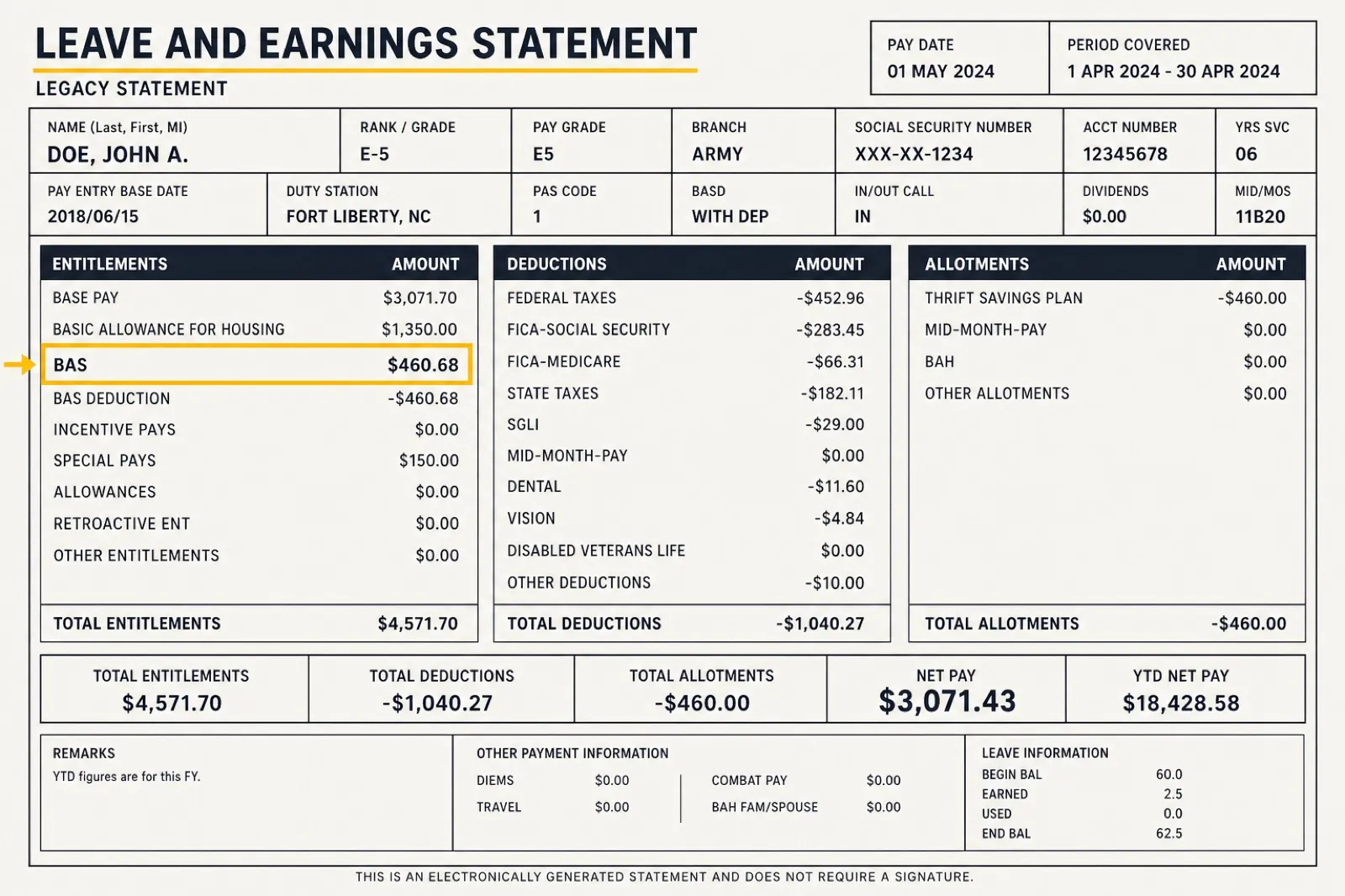
On your Leave and Earnings Statement, BAS appears as a monthly entitlement, usually labeled plainly as "BAS." If you are subject to meal deductions, you will also see a corresponding deduction line. The net of those two is what actually reaches your bank account, which is why the number on the rate table and the number you spend at the commissary are not always the same thing. If your LES entitlement looks wrong, the BAS calculator is a quick way to confirm what the standard figure should be for your category before you open a finance ticket.
The 2026 BAS Rates
For 2026, the monthly rates are:
| Category | Monthly BAS (2026) |
|---|---|
| Enlisted | $476.95 |
| Officer | $328.48 |
These rates took effect on January 1, 2026, and they hold steady for the full calendar year. BAS does not change mid-year the way BAH sometimes does, so the figure you see in January is the figure you will see in December unless your eligibility status changes.
The 2026 amounts reflect roughly a 2.4 percent increase over the 2025 rates, which were $465.77 for enlisted and $320.78 for officers. BAS adjustments are tied to the cost of food rather than to the annual basic-pay raise, so the percentage rarely matches the headline pay increase you read about each December. Some years the food index moves more than pay, some years less.
That distinction is worth holding onto, because it explains why BAS can feel like it lags or leaps in a given year. The basic-pay raise is set through the legislative and budget process and applies as a single percentage across all paygrades. BAS, on the other hand, is recalculated against the Department of Agriculture's measure of what food costs an adult. In a year where grocery prices climb sharply, BAS can rise faster than basic pay; in a flat year for food, it can lag. The two numbers are simply answering different questions, so do not expect them to move in lockstep.
One more practical note on the table above: these are flat monthly figures, not daily prorations you have to reconstruct. The system handles the per-day math behind the scenes when partial-month situations come up, such as joining or leaving active duty mid-month. For a normal full month of service, the rate is exactly what the table shows.
Why enlisted BAS is higher than officer BAS
It surprises a lot of junior service members that enlisted members get a larger food allowance than officers. There is a long-standing policy reason for it. Enlisted BAS is set using the full USDA food cost index, the same measure used to estimate what it costs an adult to feed themselves. Officer BAS is calculated under a separate, older statutory formula that produces a lower figure. The gap is not an accident or a mistake; it is written into how the two rates are computed. So in 2026 an E-3 receives more BAS than an O-3, even though the officer out-earns the enlisted member on basic pay by a wide margin.
How Meal Deductions Work
Receiving BAS does not always mean you keep all of it. The government's logic is straightforward: if it is already feeding you, it should not also pay you in full to feed yourself. That reconciliation happens through meal deductions.
If you are required to use a government dining facility, often through a program called Essential Station Messing, the cost of those provided meals is deducted from your pay. In practice many single junior enlisted members living in the barracks see their BAS entitlement and a near-equal meal deduction on the same LES, so the net effect on take-home pay is small. The allowance is technically paid, then most of it is recouped to cover the meals the government is furnishing.
This is also why field exercises, deployments, and stays where meals are provided can trigger deductions. When the government furnishes your food, expect a charge against the allowance for the days you are fed. The key thing to understand is that BAS is the entitlement and the deduction is a separate line; they are not the same number being toggled on and off. If you want to sanity-check the entitlement side before factoring in deductions, start with the BAS calculator.
When you keep the full amount
Service members who are not subject to mandatory messing, which is the typical situation for most members who live off base or are otherwise responsible for buying their own food, generally receive the full monthly BAS with no offsetting meal deduction. For them, the rate table figure is what they actually pocket each month.
This is the situation most members move into as they progress. A junior enlisted member in the barracks on Essential Station Messing may see most of their BAS recouped, but once they move off base, marry, or otherwise become responsible for their own food, the deduction typically stops and the full allowance flows through. Nothing about the entitlement amount changes when that happens; what changes is whether the government is also feeding you, and therefore whether it recoups part of the allowance. The rate is the same $476.95 either way for enlisted; only the deduction side moves.
A quick example
Picture two E-4s in 2026. Both have a BAS entitlement of $476.95. The first lives in the barracks and is on Essential Station Messing, eating at the dining facility, so a meal deduction close to the full amount appears on the same LES and the net to pocket is small. The second lives off base, buys their own groceries, and is subject to no deduction, so the full $476.95 hits their account each month. Same rank, same entitlement, very different take-home, and the only variable is who is providing the food.
Who Gets BAS II
Here is the part that sends people looking. BAS II is a higher rate, set at exactly double the standard enlisted BAS. For 2026 that works out to $953.90 per month, since the standard enlisted rate is $476.95. It is not a bonus and it is not something you apply for casually. It exists for a specific and fairly narrow situation.
BAS II is payable only to enlisted members who meet all of the following conditions at the same time:
- They are assigned to a permanent duty station, not in a temporary or field status.
- They are living in single, unaccompanied government quarters, such as a barracks or dormitory room.
- Those quarters do not have adequate food storage or meal preparation facilities, meaning no real kitchen.
- A government dining facility is not available to them, and the government cannot otherwise make meals available.

Put plainly: BAS II is for the enlisted member the government has housed in a room with no kitchen, on a base with no usable mess hall or galley, leaving them no government-furnished way to eat. Because that member has to buy and prepare all their own food in a situation the government created, they get double the normal allowance to offset the higher real-world cost.
Officers do not qualify
BAS II is an enlisted-only entitlement. An officer in the exact same no-kitchen, no-dining-facility situation does not receive BAS II. Officers are paid the standard officer BAS regardless of their quarters and messing situation, because the higher rate was written into policy specifically for enlisted members.
Why it is double, not just a little more
The doubling is deliberate. Standard BAS assumes you have at least some normal access to either a dining facility or a kitchen to prepare cheaper meals at home. A member who has neither is forced into more expensive options, takeout, prepared food, eating out, with no way to cook in bulk. Policy treats that as roughly twice the cost burden, which is where the double rate comes from. It is not a windfall so much as recognition that the cheapest way to eat, cooking at home, has been taken off the table by the assignment.
How you actually get it
BAS II is not self-elected. The determination that a member's situation qualifies, that the quarters lack food storage and that no government messing is available, is made at the installation level through the chain of command and the local commander's authority, not by the individual filing a form on a whim. If you believe your living situation meets all four conditions and you are still on standard BAS, that is a conversation for your chain of command and your servicing finance office, with the policy criteria above in hand.
Because the determination is local and situation-dependent, BAS II can also stop. If you move into quarters with a kitchen, or a dining facility comes back online and becomes available to you, the qualifying conditions are no longer all met, and the entitlement reverts to standard BAS. It tracks your living and messing reality, not a status you keep once you have earned it. That is the right way to think about it: BAS II is a fix for a specific government-created food gap, and it lasts exactly as long as the gap does.
Common BAS Mistakes and Misunderstandings
A few recurring errors are worth calling out, because they cost people money or cause needless finance tickets.
Expecting BAS to scale with dependents
It does not. If you came from the BAH side of pay, where dependents bump your rate, it is easy to assume food works the same way. It does not. BAS feeds the member only, so searching for a BAS calculator with dependents will only ever return the single-member rate. The BAS calculator shows the same figure whether you have a family or not.
Confusing the entitlement with the deposit
Because of meal deductions, the BAS line on the rate table and the dollars added to your account can differ a lot, especially for single barracks residents on Essential Station Messing. Always read the entitlement and the deduction as two separate lines.
Assuming BAS II is a raise you can request
BAS II is tied entirely to your housing and messing situation, not to merit, time in service, or a request. The four conditions either all apply or they do not. Most members in normal barracks situations with a working dining facility on base will be on standard BAS or Essential Station Messing, not BAS II.
Forgetting that BAS continues during many absences
Standard BAS generally keeps being paid in situations where you are responsible for your own meals. Deductions kick in when the government furnishes food, but the underlying entitlement does not simply vanish the moment you leave your home station. For deployment-specific pay questions, the related combat pay and tax-exclusion rules are a separate topic worth understanding alongside BAS.
BAS in the Bigger Pay Picture
BAS is a relatively small line compared with basic pay and housing, but it is steady, predictable, and tax-free, which gives it outsized value per dollar. When you are comparing offers, planning a budget, or estimating Regular Military Compensation, it belongs in the math right next to your basic pay and BAH.
For most members the practical takeaways are simple. Know your category rate, $476.95 enlisted or $328.48 officer for 2026. Understand that if the government feeds you, expect a deduction. And know that the higher BAS II rate exists for one specific enlisted situation, no kitchen and no available mess, not as a general upgrade.
If you want the cleanest read on your own numbers, including how meal deductions and your category change the bottom line, run your details through the BAS calculator. It is faster than parsing a rate memo and it keeps you from budgeting around a figure that does not match your actual situation. To see how BAS stacks alongside housing in your total compensation, the companion Best BAH Locations in 2026 guide covers the larger, location-driven half of your allowance picture.
Frequently Asked Questions About BAS
What is BAS in the military?
BAS in the military is Basic Allowance for Subsistence, a non-taxable allowance that offsets the cost of the service member's own meals. It pays a flat monthly amount regardless of rank, location, or family size, because it is calculated to feed one person. For 2026 the rate is $476.95 for enlisted members and $328.48 for officers.
How does BAS work in the military?
The government either feeds you directly or pays you BAS to feed yourself. The allowance is paid as a monthly entitlement on your LES, and if the government furnishes your meals through a dining facility, a meal deduction recoups most or all of it. When you are responsible for your own food, you keep the full amount.
Do army soldiers pay for food?
In practice, yes, in the sense that soldiers on Essential Station Messing have a meal deduction taken from their pay to cover the dining facility meals the government provides. The BAS entitlement is paid and then a near-equal deduction is applied, so the net take-home effect is small. Soldiers who buy their own groceries off base keep the full allowance.
How do you get BAS in the army?
Standard BAS is paid automatically to eligible members as part of their pay; it is not something you apply for. Your category, enlisted or officer, sets the rate, and your messing situation determines whether a meal deduction applies. If your LES entitlement looks wrong, confirm the standard figure with the BAS calculator before opening a finance ticket.
What is BAS II?
BAS II is a higher enlisted-only rate set at exactly double the standard enlisted BAS, which is $953.90 per month in 2026. It is payable only when an enlisted member is at a permanent duty station, housed in single government quarters with no kitchen, and has no available government dining facility. Officers never qualify for BAS II.
Is basic allowance for subsistence on the W-2?
No. BAS is a non-taxable allowance, so it does not appear as taxable wages in Box 1 of your W-2. Because it is excluded from federal taxable income, a dollar of BAS is worth more than a dollar of basic pay.
The Bottom Line on BAS in 2026
BAS is the food allowance, it covers only you, and it is paid at $476.95 a month for enlisted members and $328.48 a month for officers in 2026. Enlisted gets more because of how the rate is calculated, not by accident. If the government furnishes your meals, deductions claw back most or all of it. And BAS II, the doubled $953.90 enlisted rate, is reserved for the narrow case where you are housed in single government quarters with no kitchen and no dining facility available. Officers never get BAS II. Everything else is detail, and the BAS calculator handles the detail for you.