Military BAH With vs Without Dependents: How Much the Rate Changes
Military BAH with vs without dependents in 2026: how much your housing allowance changes, why family size does not matter, plus the special-case rules.

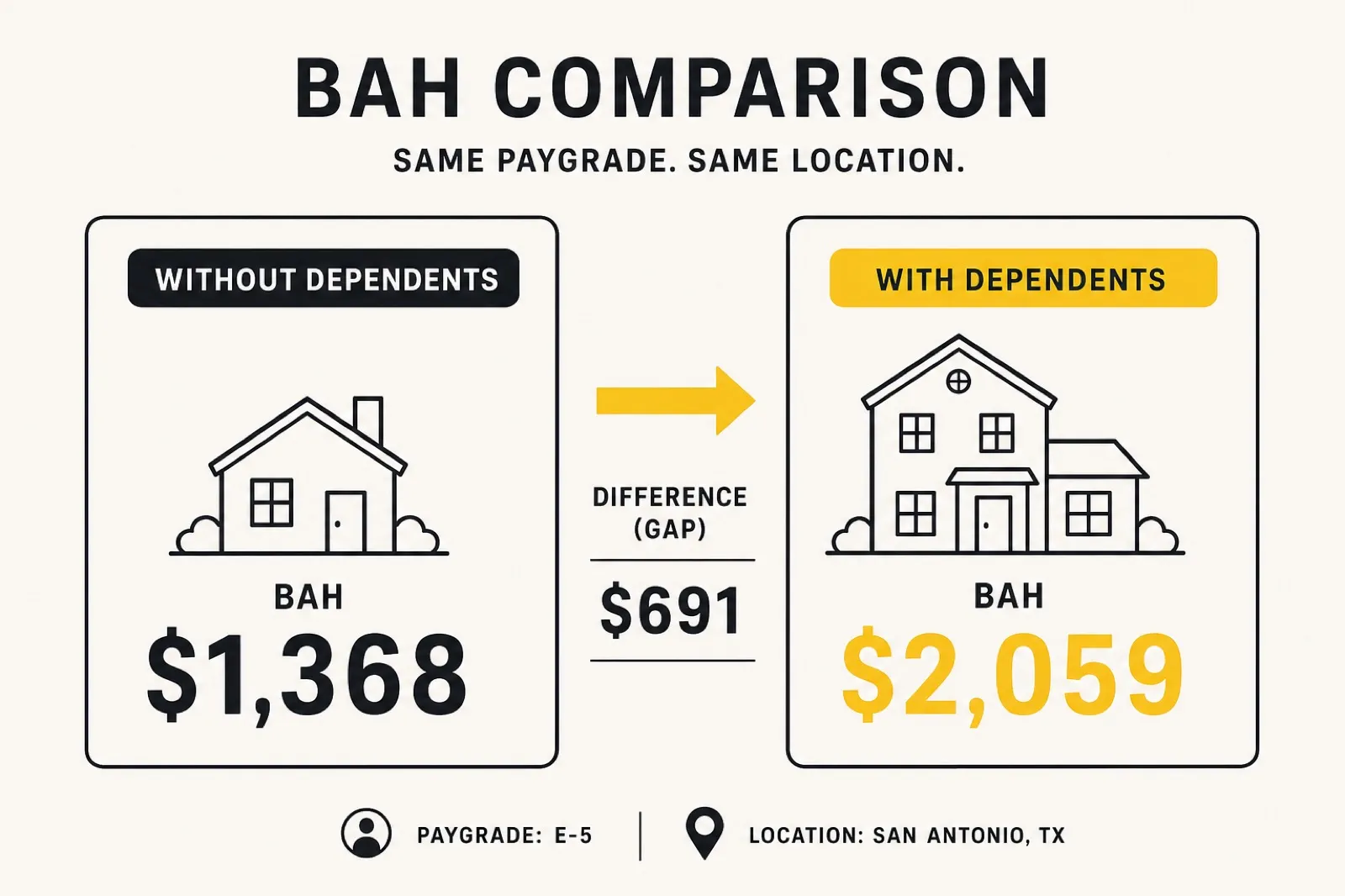
If you are about to add a spouse or a child to your record, or you are running the numbers on a marriage, a baby, or a divorce, one of the first questions that comes up is simple: how much more does military BAH, the Basic Allowance for Housing, pay when you have dependents? The short answer is that there are exactly two published rates for every paygrade in every location, a with-dependents rate and a without-dependents rate, and moving from one to the other can mean anywhere from a couple hundred dollars a month to well over a thousand, depending on where you are stationed.
The longer answer is where people get tripped up. The gap is not a fixed percentage, it does not grow when you add a second or third dependent, and there are a handful of special cases - barracks residents, members paying child support, dual-military couples, and members geographically separated from their families - where the "obvious" answer is wrong. This guide walks through how the two rates relate in 2026, how to find your exact difference, and the rules that decide which rate actually lands on your Leave and Earnings Statement.
For the precise figure at your paygrade and location, run both scenarios through the BAH calculator. It pulls the published Department of Defense rate for your Military Housing Area, paygrade, and dependent status, so you can see the real with-dependents and without-dependents numbers side by side instead of guessing at a percentage.
How Military BAH Works: The Two-Rate System in Plain Terms
Every BAH rate the DoD publishes is tied to three things and only three things: your Military Housing Area, your paygrade, and whether you have at least one dependent. The Defense Travel Management Office publishes a fresh rate file once a year, normally in mid-December for a January 1 effective date. For 2026, the national average rate rose 4.2 percent over 2025, with the new rates taking effect January 1, 2026.
Inside that file, each combination of paygrade and location has two published numbers. One is the with-dependents rate, the other is the without-dependents rate. There is no third tier. The system does not care whether your household has one person in it or seven; it only checks the yes-or-no question of whether you have a dependent recognized by the DoD.
Why family size does not change the number
This is the single most common surprise for new arrivals, so it is worth stating bluntly: the with-dependents rate is identical whether you have one dependent or five. A junior enlisted member with a new baby and a senior member with a spouse and four kids draw the same with-dependents BAH at the same paygrade in the same location. BAH is not a per-child stipend and it does not scale with household size. Other parts of your pay and benefits, such as family separation allowance or the dependents you claim on your taxes, work differently, but the housing allowance itself is a flat two-option switch.
That design is deliberate. BAH is meant to track the cost of an appropriately sized housing unit for a member at a given paygrade, not to reimburse the actual cost of feeding and raising a specific number of children. The DoD already assumes a member with dependents needs a larger unit than a single member, and the with-dependents rate bakes that assumption in once.
It also means the financial event that matters is the first dependent, not the family's growth after that. Going from single to married, or single to one child, is the change that moves your housing allowance. Everything after that first dependent leaves your BAH untouched. So if you are budgeting around a second child, do not pencil in a housing-allowance bump; it will not come. Plan instead around the entitlements that do scale, and treat the with-dependents rate as a one-time step you already captured.
How big is the gap, really
The dollar difference between the two rates is not a clean, uniform percentage. It is set market by market, because the gap reflects the real local cost difference between the smaller housing a single member is expected to occupy and the larger unit a member with a family is expected to need. In an expensive metro where the jump from a one-bedroom to a three-bedroom is steep, the with-dependents premium is large in absolute dollars. In a low-cost rural Military Housing Area, the same premium can be modest. Because of that, there is no single "BAH with dependents difference" figure that holds nationwide, and any guide that quotes one number is misleading you. The only honest answer is to look up your specific location, which is exactly what the BAH calculator does.
What Counts as a Dependent for BAH
Adding a dependent is what flips you from the lower rate to the higher one, so it matters which relationships the DoD actually recognizes. In general, the categories that establish a member as "with dependents" for BAH purposes include a lawful spouse, an unmarried child under the applicable age limit, and certain other dependents such as a parent who relies on the member for over half their support, once that relationship is formally established through the personnel system.
A few points trip people up here:
- A spouse counts the moment the marriage is legal and entered into your record. You do not have to live together for the spouse to make you "with dependents," though geographic separation has its own rules covered below.
- A child generally counts until they age out under the standard limit, with an extension available for a full-time student up to a higher age, and longer for a child who is incapable of self-support due to disability.
- A dependent must be enrolled in the Defense Enrollment Eligibility Reporting System before finance will pay the with-dependents rate. The rate does not back-pay itself automatically; the paperwork drives the payment.
If your situation is anything other than a straightforward spouse or biological child - step-children, a parent, a ward, or a child who lives with an ex - confirm the specifics with your finance office, because the documentation requirements differ and an error here changes which of the two rates you are paid.
It is also worth timing the paperwork. The with-dependents rate is not retroactive to the day you got married or the day your child was born; it generally starts from the effective date that finance recognizes the dependent, which depends on when you complete enrollment and submit the supporting documents. A marriage certificate or birth certificate that sits in a folder for two months is two months of the lower rate you do not get back in most cases. The cleanest habit is to start the enrollment the same week the life event happens, then verify on your next Leave and Earnings Statement that the rate actually changed rather than assuming the system caught up on its own.
The Special Cases Where the Obvious Answer Is Wrong
Most members are cleanly in one bucket or the other. The exceptions are where the real money mistakes happen.
Single members in the barracks get partial BAH, not the without-dependents rate
A member without dependents who is assigned to government quarters, such as the barracks, does not draw the full without-dependents BAH. Instead they receive a much smaller payment called BAH Partial. It is a flat, non-locality amount set by paygrade rather than by housing market, and it is intended to cover incidental housing-related costs rather than the cost of renting a place on the economy. The amounts are small - measured in single or low double digits per month for most paygrades - so do not plan around partial BAH as if it were real rent money.
The practical takeaway: if you are single and in the barracks, you are not getting the without-dependents locality rate you see in the calculator. You get that locality rate only when you are authorized to live off base. If you later get authorization to move off base, your pay jumps from partial BAH up to the full without-dependents rate for your location. That jump is often the largest single pay change a junior single member sees that has nothing to do with rank, so it is worth understanding exactly when your service authorizes off-base living, because that authorization, not your marital status, is what flips you from a few dollars of partial BAH to the full local rate.
Members in quarters who pay child support get BAH-Diff
There is a specific carve-out for a member who is assigned to single-type government quarters but who pays child support. That member can receive BAH-Differential, usually written BAH-Diff. It is meant to recognize that the member is supporting a dependent even though they are housed by the government and would otherwise only rate partial BAH.
Two rules matter here. First, BAH-Diff is roughly the difference between the with-dependents and without-dependents rates at the member's paygrade, drawn from a published differential table rather than from local rents. Second, you are not entitled to BAH-Diff if the monthly child support you actually pay is less than the BAH-Diff amount. In other words, the allowance cannot exceed what you are genuinely paying in support. If you are in this situation, your finance office computes the exact figure, because it interacts with both your support obligation and your quarters assignment.
Dual-military couples do not both collect the with-dependents rate
When two service members are married to each other, the housing allowance math changes. If the couple has no children, each member simply draws their own without-dependents rate for their own location. If the couple has a child or other dependent, only one of the two members draws the with-dependents rate; the other draws the without-dependents rate. They do not both get the higher figure for the same child.

The standard advice is to have the higher-ranking member claim the dependent so the household captures the larger with-dependents rate at the senior paygrade, while the junior member takes the without-dependents rate. Stationed apart, each member is paid based on their own duty location, which for a geographically separated dual-military couple can actually work out favorably. Finance will not optimize this for you automatically, so it is worth confirming the dependent is claimed under the right member.
Geographic separation from your family
If you have dependents but they do not live with you - common during an unaccompanied overseas tour, or when a child lives with a former spouse - the rules get involved. Depending on the scenario you may be paid BAH at the rate for the location where your dependents reside rather than where you are stationed, or you may rate a specific allowance tied to the separation. These cases are genuinely complicated and the right answer depends on the exact orders and family arrangement, so this is one to take to your finance office rather than self-diagnose.
How to Find Your Exact Difference
The clean way to see your number is to run both scenarios and subtract. In the BAH calculator, enter your ZIP code or duty location and your paygrade, then look up the with-dependents and without-dependents figures for that combination. The gap between them is your personal "BAH with dependents difference," and it will be accurate for 2026 because the tool reads the current published DoD rate file rather than an estimate.
A few things to keep in mind as you compare:
- The difference you find applies only to your location. Transfer on your next set of orders and the gap can change completely, because it is rebuilt from the new market's rents. If you are weighing assignments, our guide on where BAH goes furthest covers how to read a high rate without getting fooled by a high cost of living.
- The figure is gross, before taxes. BAH is non-taxable, which is part of why a dollar of BAH is worth more than a dollar of base pay. That tax treatment is the same whether you draw the with or without-dependents rate.
- BAH is separate from your food allowance. If you are mapping out your full monthly entitlements, the BAS calculator covers Basic Allowance for Subsistence, which has its own enlisted and officer rates and does not change with dependents at all.
Rate Protection: Why Your Number Should Not Drop Mid-Tour
One feature that protects you across the with and without-dependents divide is individual rate protection. The rule is that you are entitled to either the rate published on January 1 for your location, or the amount of housing allowance you were already receiving on December 31, whichever is larger. So if local rents soften and the new published rate for your paygrade and location comes in lower, your pay does not get cut while you are sitting at that duty station.
Rate protection is not unconditional, though. It lapses when your status changes in a way that resets the calculation, including a permanent change of station, a reduction in paygrade, or a change in your dependent status. That last one is the relevant catch for this guide: if you gain or lose a dependent, your rate is recomputed under the current rate file, and you are not grandfathered into your old protected number. Most of the time gaining a dependent moves you up, so it is welcome. But it is worth knowing that adding or losing a dependent is a triggering event, not a free upgrade layered on top of a protected rate.
Common Mistakes to Avoid
A few errors come up over and over when members think about the with-versus-without question:
- Assuming a percentage. There is no fixed national percentage gap between the two rates. Look up your location.
- Expecting more money for more kids. The with-dependents rate is flat regardless of family size. A second child changes your taxes and possibly other allowances, not your BAH.
- Counting on barracks BAH. Single members in government quarters get partial BAH, which is tiny, not the without-dependents locality rate.
- Both halves of a dual-military couple claiming the dependent. Only one member draws the with-dependents rate for a shared child.
- Forgetting the paperwork. The rate does not change until your dependent is enrolled in the system. Get it in the record promptly so finance pays the correct rate.
Frequently Asked Questions
What is basic allowance for housing?
Basic Allowance for Housing, or BAH, is a tax-free monthly payment that helps service members cover the cost of housing when they are not living in government quarters. The amount is set by the Department of Defense for each Military Housing Area and is tied to your paygrade and whether you have at least one dependent. It is designed to track local rental costs for an appropriately sized home rather than to reimburse your actual rent or mortgage.
What is BAH pay?
BAH pay is the housing portion of your military compensation. Unlike base pay, it is not taxed, which is part of why a dollar of BAH is worth more than a dollar of base pay. It appears as a separate line on your Leave and Earnings Statement and is paid at either the with-dependents or without-dependents rate for your location and paygrade.
What is BAH on a military pay stub?
On a military pay stub, which is officially the Leave and Earnings Statement, BAH shows up as its own entitlement line separate from base pay and BAS. Confirm the figure matches the published rate for your paygrade, location, and dependent status, because a wrong dependent status in the system means finance is paying you the wrong rate.
What is the difference between BAH with and without dependents?
The difference is a single step between two published rates: one with-dependents rate and one without-dependents rate for each paygrade in each location. The with-dependents rate is higher because it assumes a larger home, but the gap is set market by market, not as a fixed percentage, so it ranges from a couple hundred dollars to well over a thousand a month depending on where you are stationed.
What are the BAH with dependents rules?
The core BAH with dependents rules are that you draw the higher rate once you have at least one DoD-recognized dependent enrolled in the personnel system, the rate does not increase for additional dependents, and it is not retroactive to the marriage or birth date. Special cases apply to barracks residents, members paying child support, dual-military couples, and members separated from their families.
What is BAH Type II?
BAH Type II is a lower, non-locality housing rate based only on paygrade and dependent status, not on local rents. It applies in limited situations, such as members on active duty for 30 days or fewer and certain reserve-component members, and it is the same nationwide. It is generally smaller than the locality with or without-dependents rates most members receive, so do not confuse it with the standard BAH you look up by ZIP code.
The Bottom Line
BAH runs on a simple two-rate switch: with dependents or without, set per paygrade and per location, with no extra tier for additional family members. The size of the jump between the two rates is a local-market figure, not a universal percentage, so the only reliable way to answer "how much does it change" is to look up your own paygrade and duty station. The complications - partial BAH in the barracks, BAH-Diff for child support, the dual-military single-dependent rule, geographic separation, and rate protection - are the places where the headline rate and your actual pay diverge.
Run your with-dependents and without-dependents figures through the BAH calculator to see your exact 2026 difference, confirm your dependents are enrolled in the system, and take any of the special cases above to your finance office before you bank on a number. A few minutes of checking now is a lot cheaper than discovering on your LES that you were planning around the wrong rate.