2026 Military Pay Chart: Every Rank & Years of Service
The 2026 military pay chart with real monthly basic pay by rank and years of service, the 3.8% raise, and how basic pay differs from your full paycheck.

The 2026 military pay chart is the table that tells every service member exactly what their basic pay is, down to the dollar, based on two things and only two things: their paygrade and their years of service. Everything else on your Leave and Earnings Statement, the housing allowance, the food allowance, special pays, bonuses, sits on top of that one number. This guide gives you the real 2026 figures across representative ranks and years, explains the 3.8 percent raise that took effect on January 1, and shows you why basic pay is only the starting point of what you actually take home.
If you want your exact total compensation rather than basic pay alone, the BAH calculator layers your housing allowance on top using your duty ZIP code and dependency status, which for most members is the single largest add-on to base pay. Use it alongside the chart below.
How the 2026 Pay Chart Works
Military basic pay is set by federal law and published by the Defense Finance and Accounting Service. It is a grid. Down the side runs your paygrade, from E-1 at the junior enlisted end up through E-9, then the warrant officer scale W-1 to W-5, then commissioned officers O-1 through O-10. Across the top runs your time in service, broken into bands: under 2 years, over 2, over 3, over 4, over 6, and so on out to over 40.
Find the row for your grade, slide across to the column for your years of service, and the cell where they meet is your monthly basic pay before any deductions. If you would rather skip the grid, the military pay calculator does the lookup for you: pick your paygrade and years of service and it returns the exact monthly and annual figure. That figure is identical whether you serve in the Army, Navy, Air Force, Marine Corps, Space Force, or Coast Guard. The chart does not vary by branch, by job, or by location. A basic pay number is a basic pay number everywhere.
The 2026 raise: 3.8 percent across the board
Every cell in the 2026 table is 3.8 percent higher than its 2025 value. That raise took effect January 1, 2026 and first showed up in the mid-January paycheck. The figure is not arbitrary. Basic pay raises are tied by statute to the Employment Cost Index, a Bureau of Labor Statistics measure of private-sector wage growth, and the 3.8 percent reflects the ECI change between the third quarter of 2023 and the third quarter of 2024.
One narrow exception: a handful of the most senior general and flag officer cells are capped by law at Level II of the Executive Schedule, so the very top of the O-9 and O-10 rows can rise by less than the full 3.8 percent. That cap does not touch any enlisted member, any warrant officer, or any officer below the most senior tier, so it is irrelevant to the overwhelming majority of the force.
Years of service means total service, not time in grade
A point that trips up newer members: the "years of service" axis counts your total time in a uniformed service, not how long you have held your current rank. A sergeant who pinned on E-5 last month but has been in the Army for eight years sits in the "over 8" column, not the entry column. Your pay date, sometimes called your basic pay entry date, is what the chart reads, and it can differ from your promotion date by years.
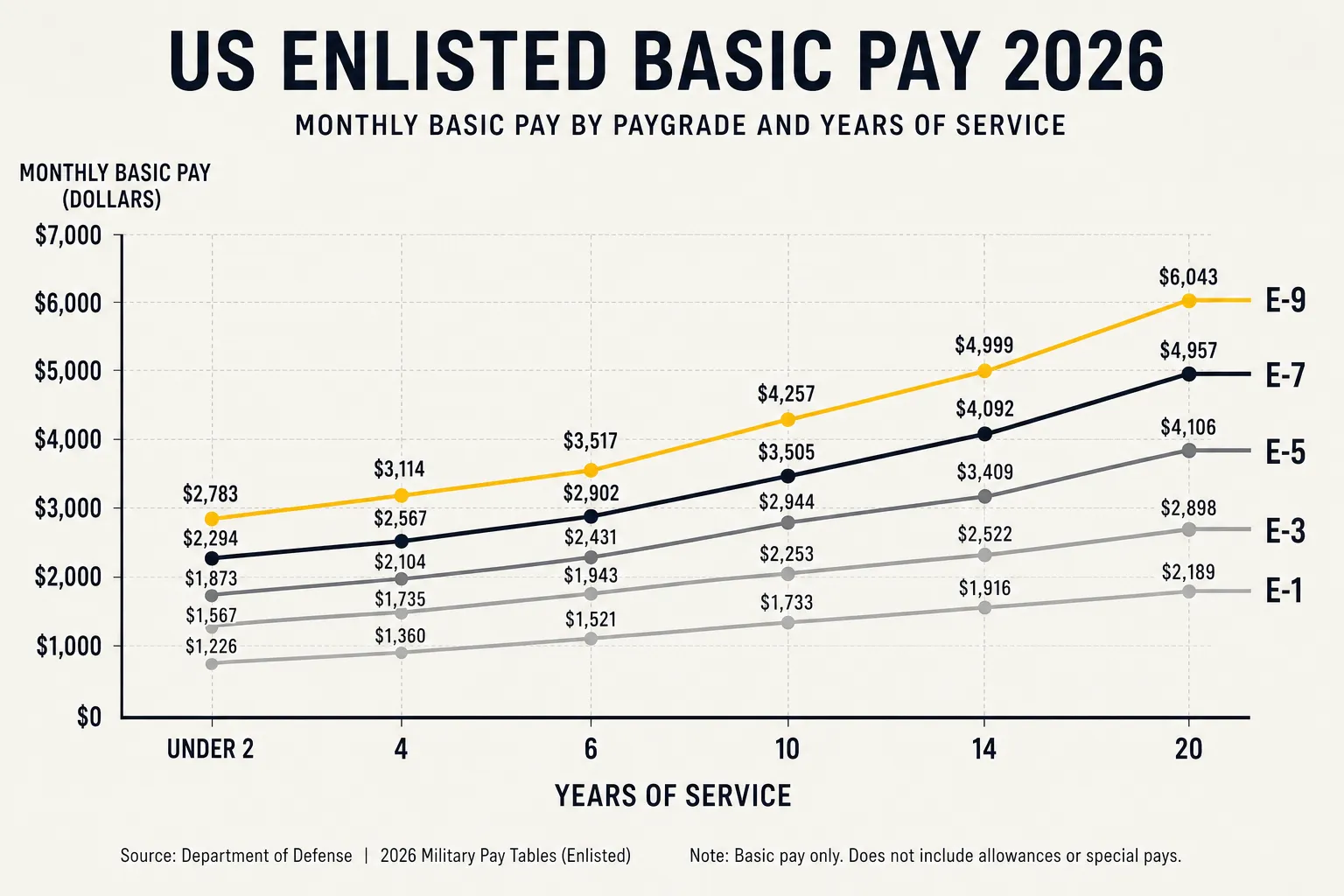
2026 Enlisted Basic Pay
Here are representative 2026 monthly basic pay figures for the enlisted grades. These are the exact published rates for the years-of-service cell shown, rounded to the nearest dollar.
| Paygrade | Years of service | 2026 monthly basic pay |
|---|---|---|
| E-1 | under 4 months | $2,226 |
| E-1 | over 4 months | $2,407 |
| E-2 | 2+ | $2,698 |
| E-3 | over 2 | $3,015 |
| E-4 | over 4 | $3,659 |
| E-5 | over 6 | $4,110 |
| E-6 | over 10 | $4,759 |
| E-7 | over 14 | $5,835 |
| E-8 | over 18 | $6,811 |
| E-9 | over 24 | $8,757 |
A few things to read out of this column.
The E-1 grade has two rates, and that is the only grade where time is measured in months rather than years. For your first four months of service you earn the lower $2,226; the day you cross four months you move to $2,407 for the rest of your time as an E-1. After that, every grade is measured in whole years.
Notice how flat the curve is at the bottom and how it steepens. The jump from E-1 to E-4 reflects routine early promotions and the longevity steps that come with simply staying in. The bigger leaps, E-6 to E-7, E-8 to E-9, are the senior noncommissioned officer tier, where promotions are competitive and slow. An E-9 with 24 years is earning roughly 3.6 times what a brand-new E-1 makes, and that gap is before you count the larger housing and special pays that senior members typically draw.
Why your paycheck is bigger than this number
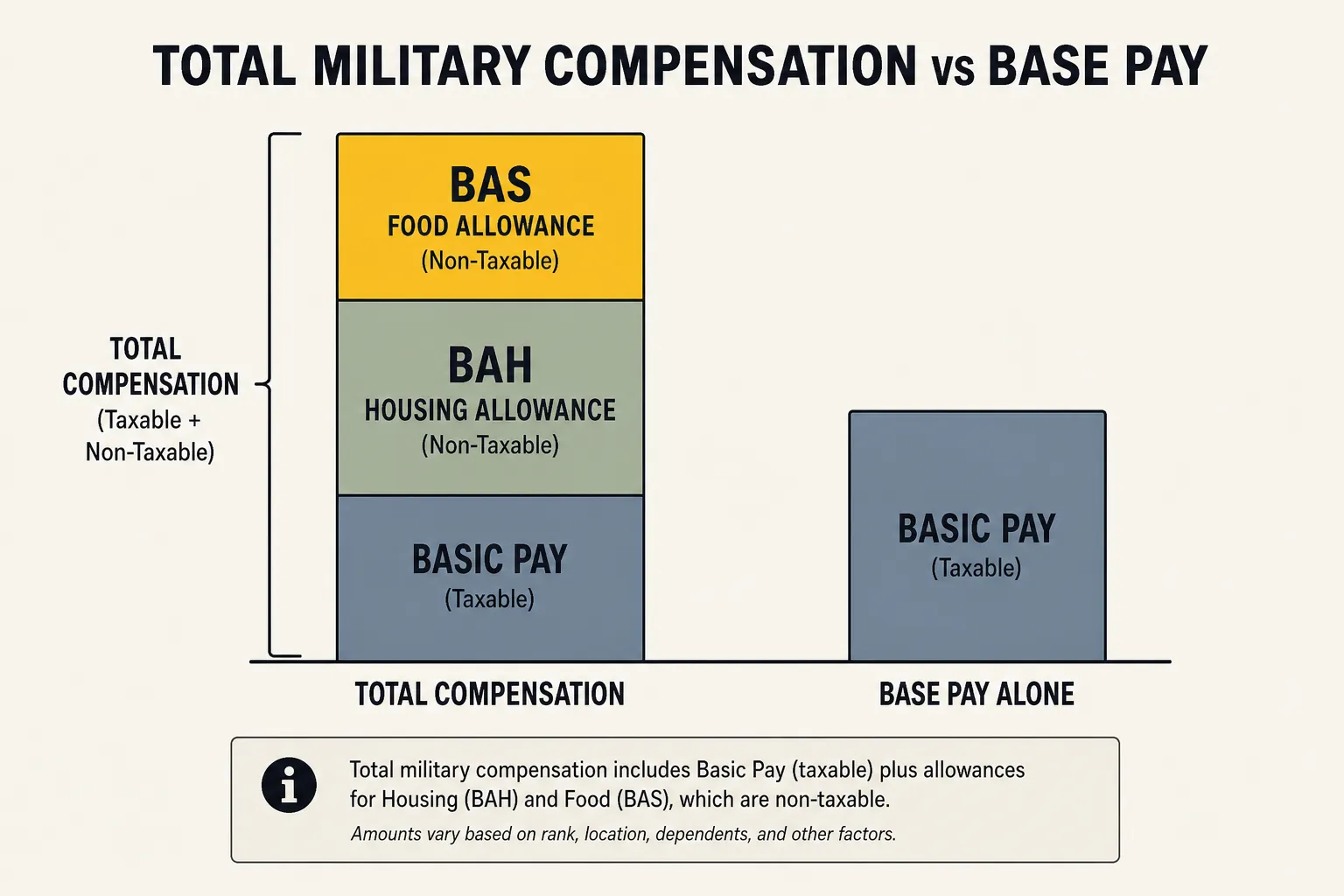
The chart above is basic pay only. It is not your gross pay and it is nowhere near your total compensation. For most members the largest single addition is the Basic Allowance for Housing, a tax-free monthly payment that varies by duty ZIP code, paygrade, and whether you have dependents. In high-cost areas BAH can rival or exceed basic pay itself. On top of that sits the Basic Allowance for Subsistence for food, plus any special and incentive pays your job qualifies for.
Because BAH swings so widely by location, the only way to see your real number is to run your own ZIP code through the BAH calculator. National BAH rates rose 4.2 percent for 2026 and the food allowance rose 2.4 percent, so both allowances climbed faster than the 3.8 percent basic pay raise this year. That is one reason your total 2026 paycheck may be up more than 3.8 percent even though the headline pay raise was 3.8 percent.
2026 Officer Basic Pay
Commissioned officers start materially higher than enlisted members and the gap widens with grade. Representative 2026 monthly figures:
| Paygrade | Years of service | 2026 monthly basic pay |
|---|---|---|
| O-1 | under 2 | $4,150 |
| O-2 | over 2 | $5,446 |
| O-3 | over 6 | $7,737 |
| O-4 | over 10 | $9,419 |
| O-5 | over 16 | $11,392 |
| O-6 | over 20 | $13,115 |
A second-lieutenant or ensign (O-1) starts at $4,150 a month, already well above a mid-career E-5. By the time an officer reaches O-4, a major or lieutenant commander with a decade in, basic pay is north of $9,400. A full colonel or Navy captain (O-6) at 20 years is past $13,000 a month in basic pay alone.
There is one structural quirk worth knowing. The O-1 through O-3 rows have a "prior enlisted" variant, written O-1E, O-2E, and O-3E. These pay a higher rate to officers who were commissioned after at least four years of enlisted service, recognizing that experience. An O-3E earns noticeably more than a plain O-3 at the same years of service. If you commissioned through a path like Officer Candidate School after enlisted time, check the E-coded rate, not the standard one, and confirm which one your service is paying you.
Warrant officers sit between the two scales
Warrant officers (W-1 through W-5) are technical specialists who occupy their own pay scale between senior enlisted and commissioned officers. A W-2 with over 6 years of service earns roughly $5,586 a month in 2026 basic pay, comparable to a senior O-2 and well above a same-tenure enlisted member. Warrant pay rises steadily across the W-2 through W-5 grades and rewards deep specialization over a long career.

Reading the Chart for Your Real Situation
The published cells above are accurate, but they are a sample. The full 2026 table has dozens of years-of-service columns per row, and your exact cell depends on your precise pay date. A few practical cautions when you use any pay chart, including this one.
Match the column to your pay date, not your gut
The longevity bands matter. An E-6 at 8 years and an E-6 at 12 years are in different columns with different pay. If you are near a longevity step, your basic pay bumps up automatically the month you cross it, with no promotion required. Check your Leave and Earnings Statement for your pay entry base date and count forward from there.
Basic pay drives your retirement, so the chart matters for life
Your eventual pension is calculated from your basic pay, specifically the average of your highest 36 months, not from your allowances. That makes the basic pay figure the one number that follows you into retirement. A late-career promotion that raises your basic pay in your final three years raises your pension for the rest of your life. If you are weighing how today's paygrade translates into a future check, walk through the math in the BRS vs High-3 retirement guide and model your own numbers in the retirement calculator.
Guard and Reserve read the same chart differently
Drilling Guard and Reserve members use the identical basic pay table, but they are paid per drill period rather than per month. The standard formula is that one full month of active-duty basic pay equals 30 days of pay, so a single drill day is 1/30th of the monthly figure in the chart, and a typical drill weekend of four periods pays 4/30ths. Annual training and active-duty orders pay the full monthly rate. So the chart is your reference either way; you just scale it to the days you actually serve.
The chart resets every January, so use the current year
Basic pay rates change once a year, every January 1, and the new chart fully replaces the old one. A 2025 figure is simply wrong for a 2026 paycheck, even though the difference is "only" 3.8 percent, because that gap compounds into your retirement average and into any pay computed as a multiple of monthly basic pay, such as continuation pay or separation pay. When you look up a number, confirm you are reading the year that matches the pay period in question. The figures in this guide are the 2026 rates effective January 1, 2026; a year from now the same cells will be higher by whatever raise the next defense authorization sets.
How Basic Pay Fits Into Total Compensation
It is worth stating plainly because new members consistently underestimate it: basic pay is often little more than half of what the military actually spends to compensate you. The pieces that do not appear on the pay chart include:
- Basic Allowance for Housing, tax-free, location-based, frequently the biggest single line after basic pay. Run yours in the BAH calculator.
- Basic Allowance for Subsistence, a flat monthly food allowance, also tax-free.
- The tax advantage of those allowances. Because BAH and BAS are not taxable, their real value is higher than an equal amount of taxable basic pay. This is the tax-free allowance benefit that makes military pay go further than the gross figure suggests.
- Special and incentive pays, for hazardous duty, flight status, sea duty, language skills, hard-to-fill specialties, and more.
- Retirement, health care, and education benefits, which carry real dollar value even though they never hit your bank account as cash.
When the Defense Department totals all of this, it calls the result Regular Military Compensation. The basic pay chart is the foundation of that figure, but it is only the foundation. To see your own stacked total rather than basic pay in isolation, start with the BAH calculator and add your allowances to the chart figure for your grade.
Frequently Asked Questions
How much is the 2026 military pay raise?
Basic pay rose 3.8 percent for 2026, effective January 1, 2026, across every enlisted grade, every warrant officer grade, and nearly every officer grade. The figure is set by a statutory formula tied to the Employment Cost Index. Only the most senior general and flag officer cells, capped by law at Level II of the Executive Schedule, may have received less than the full 3.8 percent.
What is the difference between basic pay and total pay?
Basic pay is the single figure on the pay chart, determined by your paygrade and years of service. Total pay, or total compensation, adds your tax-free Basic Allowance for Housing, your Basic Allowance for Subsistence, and any special or incentive pays you qualify for. For many members the allowances push total cash compensation well above basic pay, and BAH in a high-cost area can rival the basic pay figure on its own.
How much does an E-5 make in 2026?
An E-5 with over 6 years of service earns about $4,110 a month in basic pay in 2026. That is basic pay only. The same E-5 also draws BAH based on duty location and dependents, plus the food allowance, so actual take-home compensation is meaningfully higher. Run the BAH calculator with your ZIP code to see the full number.
Do officers and enlisted use the same pay chart?
They use the same published table but different sections of it. Enlisted grades run E-1 through E-9, warrant officers W-1 through W-5, and commissioned officers O-1 through O-10, each with its own rows. Officers start higher and climb faster. There are also prior-enlisted officer rates (O-1E, O-2E, O-3E) that pay more to officers who served at least four years enlisted before commissioning.
Is military basic pay taxed?
Yes. Basic pay is taxable federal income, just like civilian wages, and is subject to federal income tax and, depending on your state of legal residence, possibly state income tax. What is not taxed are the allowances, BAH and BAS, which is why those allowances are worth more than the same dollar amount of basic pay. Pay earned in a designated combat zone can also be excluded from taxable income.
How does years of service affect my pay?
Within a single paygrade, your pay rises automatically as you cross longevity steps, with no promotion required. The chart measures total years in a uniformed service from your pay entry base date, not time in your current rank. Crossing a step, say from "over 8" to "over 10," bumps your basic pay the same month, which is why checking your exact pay date against the column matters.
Bottom Line
The 2026 military pay chart gives every service member a precise basic pay figure built from just two inputs, paygrade and years of service, all raised 3.8 percent on January 1, 2026. The representative figures here, from $2,226 for a brand-new E-1 to $13,115 for an O-6 at 20 years, are the published rates for the cells shown. But basic pay is the floor, not the ceiling. Your real compensation stacks tax-free housing and food allowances and any special pays on top of that number, and in many locations the allowances rival basic pay itself. Find your grade in the chart above for your basic pay, then run the BAH calculator with your duty ZIP to see what you actually take home, and use the retirement calculator to see how today's basic pay shapes the pension that figure earns you for life.