2026 Military Pay Raise: How Much Bigger Is Your Paycheck
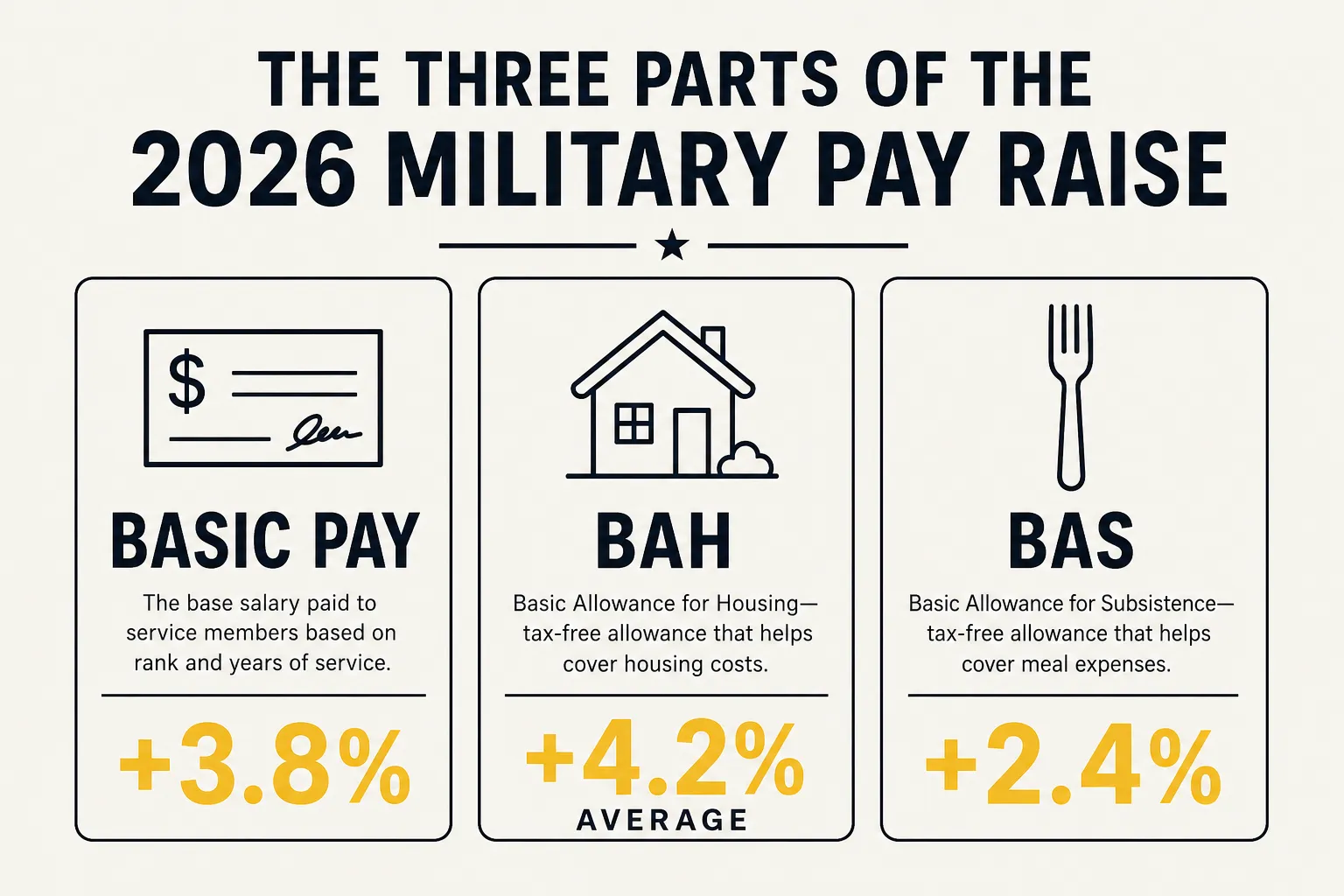
The 2026 military pay raise is 3.8% across all ranks, plus a 4.2% average BAH bump and a 2.4% BAS increase. Here is how much bigger your paycheck actually gets.

The 2026 military pay raise is 3.8 percent, and it applies to basic pay for every rank across the active force, the Guard, and the Reserve. It took effect on January 1, 2026. That is the headline number, and it is accurate, but it is also only one of three moving parts in your compensation. Your housing allowance and your food allowance changed on the same date by different amounts, and which of the three matters most to your wallet depends entirely on your rank, where you live, and whether you draw a housing allowance at all.
This guide breaks down all three pieces, shows you how to figure out the real dollar change in your paycheck rather than a vague percentage, and explains why two service members of the same rank can see very different raises. To see the post-raise figure for your own rank, start with the military pay calculator for your new basic pay, then run your BAH on top of it for the full picture as you read.
The Short Version
For 2026 there are three separate increases, and they are not the same size:
- Basic pay rose 3.8 percent for all ranks, effective January 1, 2026. This is the across-the-board raise people usually mean when they say "the pay raise."
- Basic Allowance for Housing (BAH) rose 4.2 percent on average, effective January 1, 2026. The word "average" matters: your specific area may have gone up more, gone up less, or even dropped.
- Basic Allowance for Subsistence (BAS) rose 2.4 percent, to $476.95 a month for enlisted members and $328.48 for officers, effective January 1, 2026.
Your total raise is the sum of those three working on your own numbers. A junior enlisted member living in the barracks with no BAH sees almost the entire benefit from the 3.8 percent basic pay bump. A senior member in a high-cost area drawing full housing allowance may get a bigger dollar swing from the BAH change than from the basic pay change. The percentages tell you the direction. Only your own pay statement, or a calculator fed your inputs, tells you the dollars.
How the 2026 Basic Pay Raise Was Set
The 3.8 percent figure is not arbitrary, and it is not a number a politician picked. Military basic pay raises run on an automatic formula written into law.
The Employment Cost Index drives it
Under Title 37 of the U.S. Code, the annual military basic pay adjustment is tied to the Employment Cost Index (ECI), a Bureau of Labor Statistics measure of how fast private-sector wages and salaries are growing. The law sets the raise equal to the rise in the ECI from the third quarter of one year to the third quarter of the next, measured on a lag. For the 2026 raise, that comparison window produced 3.8 percent.
The mechanism is meant to keep military pay tracking civilian wage growth so that a uniform stops becoming a pay cut relative to the outside job market. Congress and the President can override the formula in either direction through the annual defense bill, but if they do nothing, the ECI figure becomes law automatically.
Congress let the formula stand for 2026
For 2026 they did nothing to change it. The Fiscal Year 2026 National Defense Authorization Act did not include an alternate pay authorization, so the statutory 3.8 percent took effect on its own on January 1, 2026. The defense authorization bill was signed into law in December 2025.
That is worth underlining because 2026 looks different from the year before it. The 2025 cycle was unusual: it paired a general raise with a large, targeted increase for junior enlisted members in paygrades E-1 through E-4, who saw a much steeper bump than the rest of the force. 2026 did not repeat that. The 2026 raise is a single, uniform 3.8 percent applied to every paygrade equally, with no separate junior enlisted boost layered on top. If you are a junior enlisted member who joined in time to catch the 2025 targeted raise, your 2026 increase is the standard 3.8 percent on the higher base you already reached, not another outsized jump.
What 3.8 Percent Actually Means in Your Paycheck
A percentage is easy to quote and easy to misread. Here is how to turn it into a real number, and where the common mistakes hide.
Apply it to basic pay only
The 3.8 percent applies to your basic pay, also called base pay. It does not apply to your allowances, which have their own separate adjustments covered below, and it does not apply to special or incentive pays unless those are specifically tied to basic pay rates.
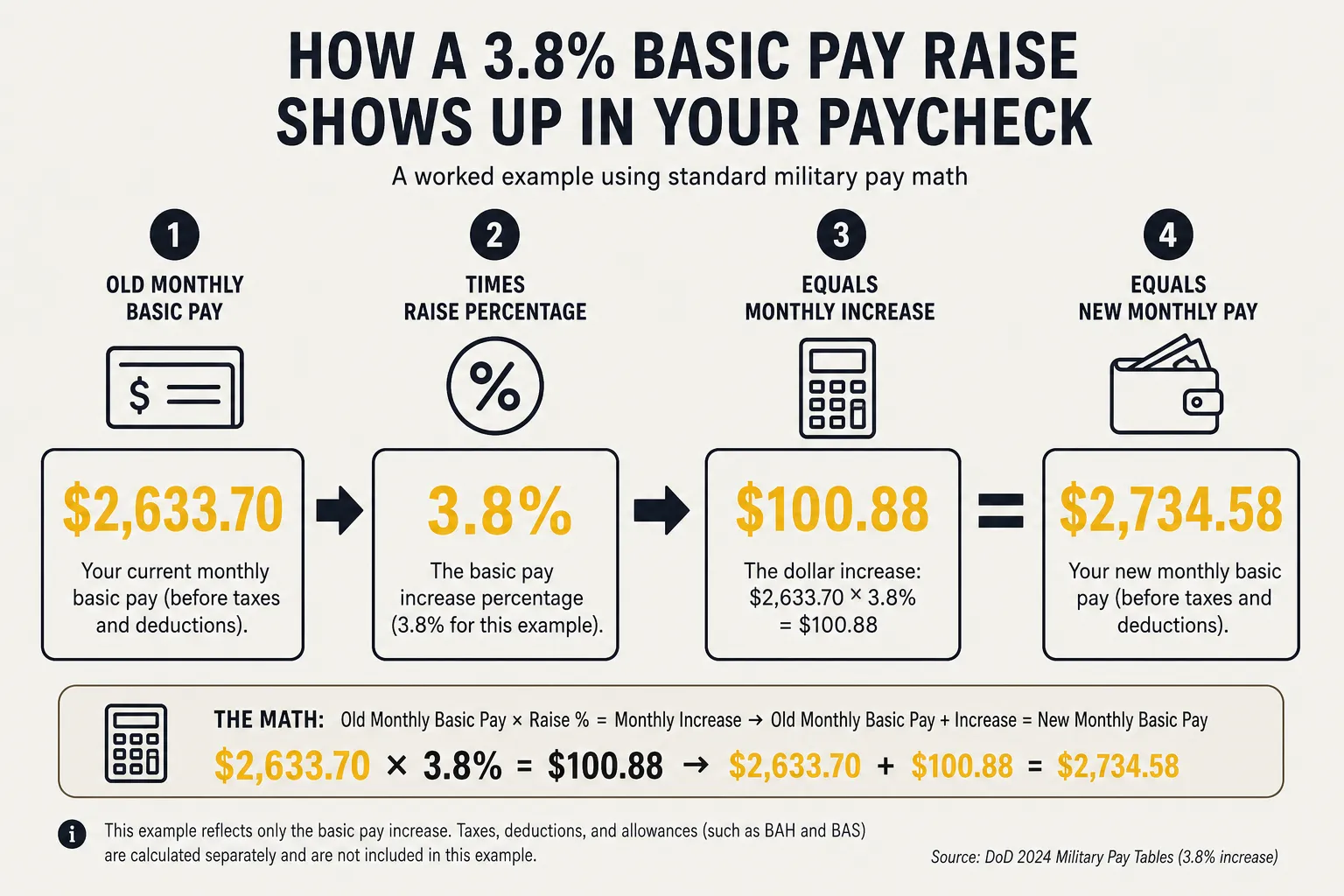
So the arithmetic is straightforward: take your December 2025 monthly basic pay and multiply by 1.038. The difference is your monthly basic pay raise. Multiply that monthly difference by 12 for the annual figure. Because basic pay rises with both paygrade and years of service, a member who also crossed a longevity step or got promoted in early 2026 will see a larger jump than 3.8 percent, since the raise and the step increase stack.
A worked example of the math
Say a member earned $4,000 a month in basic pay in December 2025. The 2026 raise lifts that to $4,152 a month ($4,000 x 1.038), a difference of $152 a month, or $1,824 over the year, before taxes. A member at $6,000 a month sees $228 more monthly and $2,736 a year. The higher your basic pay, the more dollars the same 3.8 percent puts in your pocket, which is why the flat percentage produces wildly different dollar outcomes across the rank structure.
Two cautions on that example. First, it is basic pay only, so it understates your total gross because it ignores the allowance changes. Second, taxes apply to basic pay, so your take-home increase is smaller than the gross figure. Allowances like BAH and BAS, by contrast, are not federally taxed, which is part of why they punch above their weight in your real budget.
The BAH Increase: 4.2 Percent on Average
For most members who live off base or draw a housing allowance, the BAH change is as important as the basic pay raise, sometimes more so.
What changed and when
The Department of Defense released the 2026 BAH rates in December 2025, and they took effect January 1, 2026, with an average increase of 4.2 percent nationwide. BAH is the tax-free allowance that helps cover housing costs when you are not living in government quarters, and the rate you receive depends on three things: your paygrade, your duty location, and whether you have dependents.
Why "average" is the key word
The 4.2 percent is a national average, not a guarantee for your ZIP code. BAH rates are recalculated every year against local rental market data, so your specific Military Housing Area might have risen more than 4.2 percent, risen less, or in a softening market actually fallen. If the data says your area's rate should drop, there is an important protection: individual rate protection means members already receiving BAH at that location keep their existing, higher rate as long as their status does not change. You do not get cut. New arrivals to that area, or members who change paygrade or dependency status, get the new lower rate.
That is exactly why a flat percentage cannot tell you your real number. To see the actual 2026 BAH for your rank, location, and dependent status, run it through the BAH calculator. For where the 2026 rates moved the most, the best BAH locations guide breaks it down by area.
Dependents change the number significantly
BAH pays a higher rate to members with dependents than to those without, at the same paygrade and location. The gap is meaningful, often a few hundred dollars a month. If your family situation changed, the BAH calculator will show both the with-dependents and without-dependents figures so you can see the difference. The BAH with vs without dependents guide walks through how that distinction works.
The BAS Increase: 2.4 Percent
The third lever is the smallest but the simplest. Basic Allowance for Subsistence is the tax-free food allowance, and it rose 2.4 percent for 2026.
The 2026 rates
Effective January 1, 2026, BAS pays:
| Member type | 2026 monthly BAS |
|---|---|
| Enlisted | $476.95 |
| Officer | $328.48 |
BAS does not vary by paygrade. An E-3 and an E-9 receive the same enlisted rate, and an O-1 and an O-6 receive the same officer rate. It also does not change with dependents. The only common variation is BAS II, a higher rate for certain enlisted members living in government quarters without adequate food storage or access to a dining facility, which is not automatic and must be authorized. Because BAS is tied to the cost of food rather than wages, its annual adjustment runs on a different measure than the basic pay raise, which is why its 2.4 percent does not match the 3.8 percent on basic pay.
Putting the Three Together: Your Real 2026 Raise
Here is the part that trips people up. Your true raise is not "3.8 percent." It is the combined dollar effect of three different percentages applied to three different parts of your pay, weighted by how big each part is for you specifically.
| Pay component | 2026 change | Taxed? | Who it matters most to |
|---|---|---|---|
| Basic pay | +3.8% (all ranks) | Yes | Everyone, scales with rank and longevity |
| BAH | +4.2% average | No | Members drawing housing allowance off base |
| BAS | +2.4% (to $476.95 / $328.48) | No | Everyone, flat dollar amount |
Think of it in two profiles. A single junior enlisted member living in the barracks draws little or no BAH and eats in the dining facility, so almost their entire raise comes from the 3.8 percent on basic pay, which is the smallest base of the three for them in absolute dollars. A married mid-career member living off base in a high-cost area gets all three, and the BAH portion alone may add more monthly dollars than the basic pay raise does, because the housing allowance can rival or exceed basic pay in expensive markets.
The lesson is to stop quoting yourself a single percentage. Add the three dollar changes that actually apply to your situation. Run your BAH and your BAS figures, add the basic pay difference, and you have your real number. If you are stationed in a high-cost area inside the continental U.S., a cost-of-living allowance (CONUS COLA) may also be in the mix; the CONUS COLA calculator shows whether your location qualifies.
How to Confirm the Raise Hit Your Account
Do not assume the new rate posted correctly. Verify it.
Check your January LES
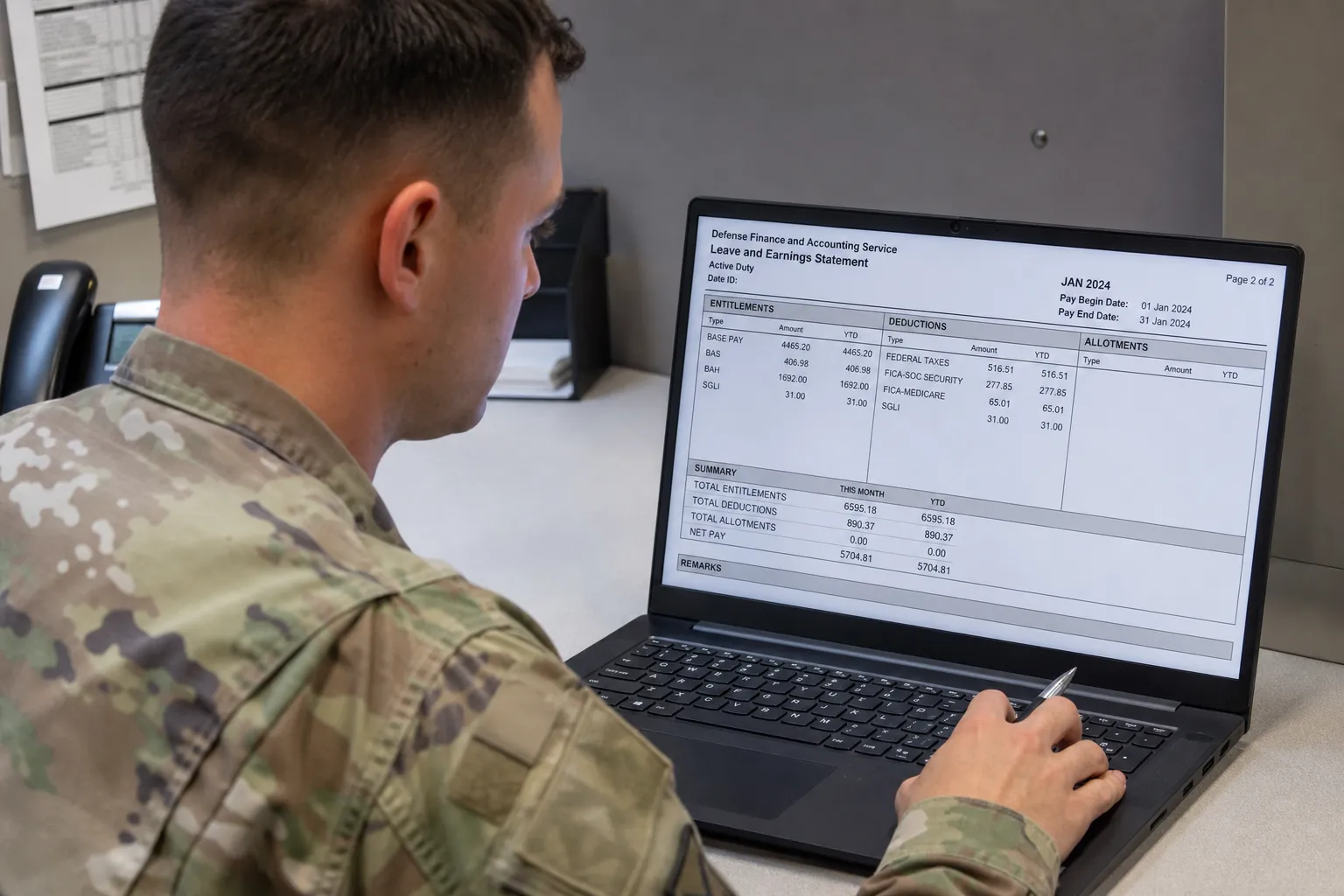
The cleanest proof is your January Leave and Earnings Statement (LES). The new basic pay rate, BAH, and BAS all take effect January 1, so the first full pay period of the year should reflect them. Pull up your January LES in MyPay and compare the basic pay line against the 2026 figure for your paygrade and years of service. If it still shows the 2025 amount, something did not update, and you should flag it to your finance office.
Watch for the mid-month timing quirk
Military pay is typically split into two payments a month, on the 1st and the 15th. Depending on processing timing, the very first payment of January may not always reflect a brand-new rate cleanly, but by your January LES the full month should be correct. If you got promoted or crossed a longevity step at the same time, confirm both the raise and the step are reflected, since those are separate adjustments that should both appear. The how to read your LES guide walks through every line on the statement if you want to audit it carefully.
Common Mistakes to Avoid
A handful of misreads come up every January:
- Applying 3.8 percent to your whole paycheck. The basic pay raise applies to basic pay only. Your allowances move on their own separate percentages, so multiplying your gross pay by 1.038 overstates the raise.
- Expecting your BAH to rise exactly 4.2 percent. That is a national average. Your specific Military Housing Area may have moved more, less, or down. Check your own location rather than assuming the average.
- Forgetting the raise is taxable but allowances are not. The basic pay increase is subject to income tax, so your take-home gain is smaller than the gross. The BAH and BAS increases are tax-free, which makes them worth more per dollar than the headline suggests.
- Confusing 2026 with the 2025 junior enlisted boost. 2025 had a large targeted increase for E-1 through E-4 on top of the general raise. 2026 is a uniform 3.8 percent for all ranks with no separate junior enlisted bump. If you were expecting another outsized jump, that is not how 2026 worked.
- Not verifying it posted. Rates occasionally fail to update for an individual record. Check your January LES against the published figure and report any mismatch to finance.
Frequently Asked Questions
How much is the 2026 military pay raise?
The 2026 military basic pay raise is 3.8 percent, applied across all ranks for the active force, the Guard, and the Reserve, effective January 1, 2026. Separately, Basic Allowance for Housing rose an average of 4.2 percent and Basic Allowance for Subsistence rose 2.4 percent on the same date. Your total dollar raise is the combined effect of all three on your own paygrade, location, and dependent status.
When did the 2026 pay raise take effect?
All three increases took effect January 1, 2026. The new basic pay, BAH, and BAS rates should appear on your January Leave and Earnings Statement. If your January LES still shows 2025 figures, contact your finance office, because the update may not have posted to your record.
Why is the 2026 raise 3.8 percent?
Military basic pay raises are set by law and tied to the Employment Cost Index, a Bureau of Labor Statistics measure of private-sector wage growth, measured on a lag. The 2026 figure of 3.8 percent reflects that ECI calculation. Congress and the President can override the formula through the annual defense authorization act, but for 2026 they did not, so the statutory 3.8 percent took effect automatically.
Did junior enlisted get a bigger raise in 2026?
No. 2026 applied the same 3.8 percent to every paygrade. The large targeted increase for junior enlisted members in paygrades E-1 through E-4 happened in the 2025 cycle, not 2026. Junior enlisted members in 2026 receive the standard 3.8 percent on the higher base they already reached after the 2025 adjustment.
How much did BAH go up in 2026?
BAH rose an average of 4.2 percent nationwide for 2026, effective January 1. That is a national average, not a guarantee for your area. Some Military Housing Areas rose more, some less, and a few declined. If your area's rate dropped, individual rate protection lets you keep your existing higher rate as long as your paygrade, location, and dependency status do not change. Use the BAH calculator to see your exact 2026 rate.
Is the 2026 pay raise taxed?
The basic pay portion of the raise is subject to federal income tax, so your take-home increase is smaller than the gross. The BAH and BAS increases are not federally taxed, which makes each of those dollars worth more in your budget than a taxable basic pay dollar. That tax difference is one reason the housing and food allowance changes carry real weight even when their percentages look modest.
Bottom Line
The 2026 military pay raise is genuinely 3.8 percent on basic pay for every rank, effective January 1, 2026, set by the automatic Employment Cost Index formula and left in place by the Fiscal Year 2026 defense authorization act. But the figure that lands in your account is the sum of three separate moves: 3.8 percent on basic pay, an average 4.2 percent on BAH, and 2.4 percent on BAS to $476.95 enlisted and $328.48 officer. Which one matters most is personal, driven by your rank, your location, and whether you draw a housing allowance. Stop quoting yourself a single percentage. Run your real BAH and BAS numbers, add your basic pay difference, confirm it all landed on your January LES, and you will know exactly how much bigger your 2026 paycheck is.