VA Disability Back Pay: How Effective Dates & Lump Sums Work
How VA disability back pay works in 2026 - effective dates, the intent to file rule, retroactive lump sums, PACT Act dates, and how to estimate what you are owed.

VA disability back pay is the money the VA owes you for the stretch of time between your effective date and the day your claim is finally approved. Claims take months, sometimes more than a year, and you do not lose the benefits that piled up while you waited. When the rating decision lands, the VA pays that accumulated amount as a single retroactive lump sum, then starts your regular monthly checks. The whole thing turns on one piece of paperwork most people barely think about: the date the VA agrees your benefit should start. That date, the effective date, is what decides whether your back pay is a few hundred dollars or several thousand.
This guide explains exactly how the VA sets your effective date, how that date converts into a back-pay total, the intent-to-file trick that protects an earlier date, and the special PACT Act rules still in play in 2026. Because the dollar amount depends on your rating, your dependents, and how many months are involved, I will point you to the VA disability calculator to estimate your own figure rather than quote example numbers that would not match your situation.
What VA Disability Back Pay Actually Is
Back pay, also called retroactive pay, is not a bonus or a special award. It is simply the benefit you were already entitled to, paid late because claims take time to process.
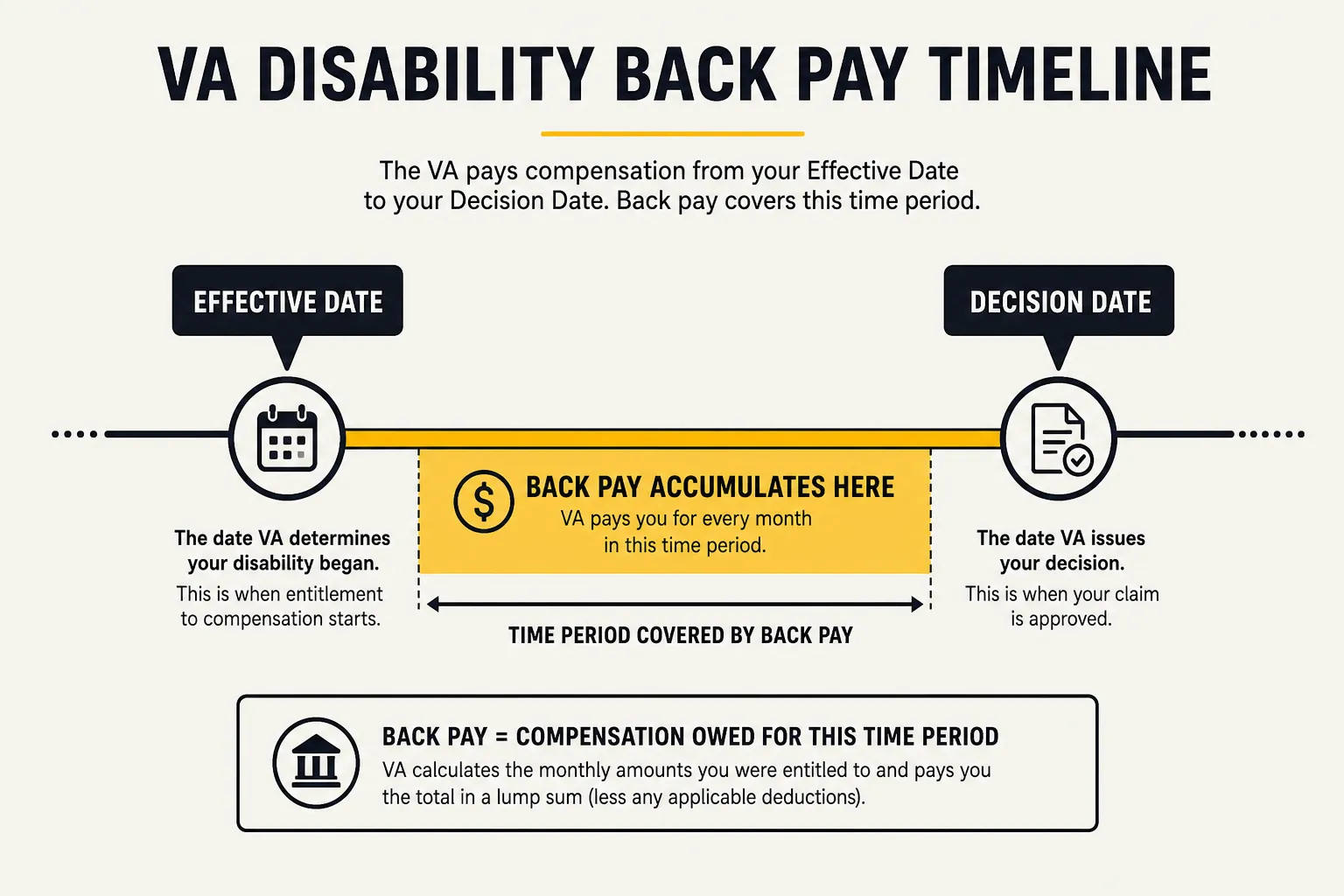
Here is the mechanics. Every approved disability claim gets two dates. The first is the effective date, which is the day your benefit legally begins. The second is the decision date, the day the VA finishes reviewing and grants the claim. The VA cannot pay you in real time for the months in between, so once the decision is made it adds up all the monthly payments you should have received from the effective date forward and sends them in one lump sum. After that catch-up payment, you move onto the normal monthly schedule.
If your decision notice shows a rating of at least 10 percent, the VA says you will receive your first payment within 15 days of the decision. That first deposit usually includes both your back pay and your first regular month, though large or complex awards can take longer to fully process.
How the VA Sets Your Effective Date
This is the part that matters most, because everything about your back-pay total flows from it. The effective date is not simply the day you filed. The rules differ depending on the type of claim, and a few of them are surprisingly generous if you act in time.
Filing within one year of separation
If you file an original disability claim within one year of leaving service, the effective date can reach all the way back to the day after your separation. In the VA's words, the effective date is the day after separation or the date your disability began, whichever applies, as long as the claim arrives inside that first year. This is the single biggest reason transitioning service members are told to file the moment they have their DD-214 in hand. Wait fifteen months and you forfeit roughly a year of back pay you could have kept.
Filing more than a year after separation
If you file later than one year after discharge, the rules tighten. For a standard direct-service-connection claim, the effective date becomes the date the VA receives your claim, not the date your condition actually started. You do not get to reach back to discharge anymore. The clock for back pay starts when your paperwork lands.
Presumptive conditions
For conditions the VA presumes are connected to service, such as many of those covered under the PACT Act, the timing rules have their own wrinkle. File within a year of separation and the effective date is generally the date your illness or injury began. File later and the effective date is the date the VA receives the claim or the date the condition began, whichever is later.
Claims for an increased rating
If your service-connected condition gets worse and you file for a higher rating, the VA can date the increase back to the earliest point you can prove the condition worsened, but only if your claim arrives within one year of that worsening. Miss that one-year window and the effective date snaps to the date the VA receives the new claim. So if your knee clearly degraded eight months ago and you have the medical records to show it, filing now can recover those eight months. Sit on it past a year and you lose them.
Reopened and supplemental claims
When you reopen a previously denied claim with new evidence, the effective date is the date the VA receives the request to reopen, or the date the condition began, whichever is later. Reopening rarely reaches back to your original filing date, which is why winning the first time, or appealing quickly, protects far more back pay than starting over later.
The Intent to File Rule: Your Most Powerful Tool
If you remember one thing from this guide, make it this. The intent to file is the cleanest way to lock in an early effective date while you gather evidence, and most people who lose back pay lose it because they never used it.
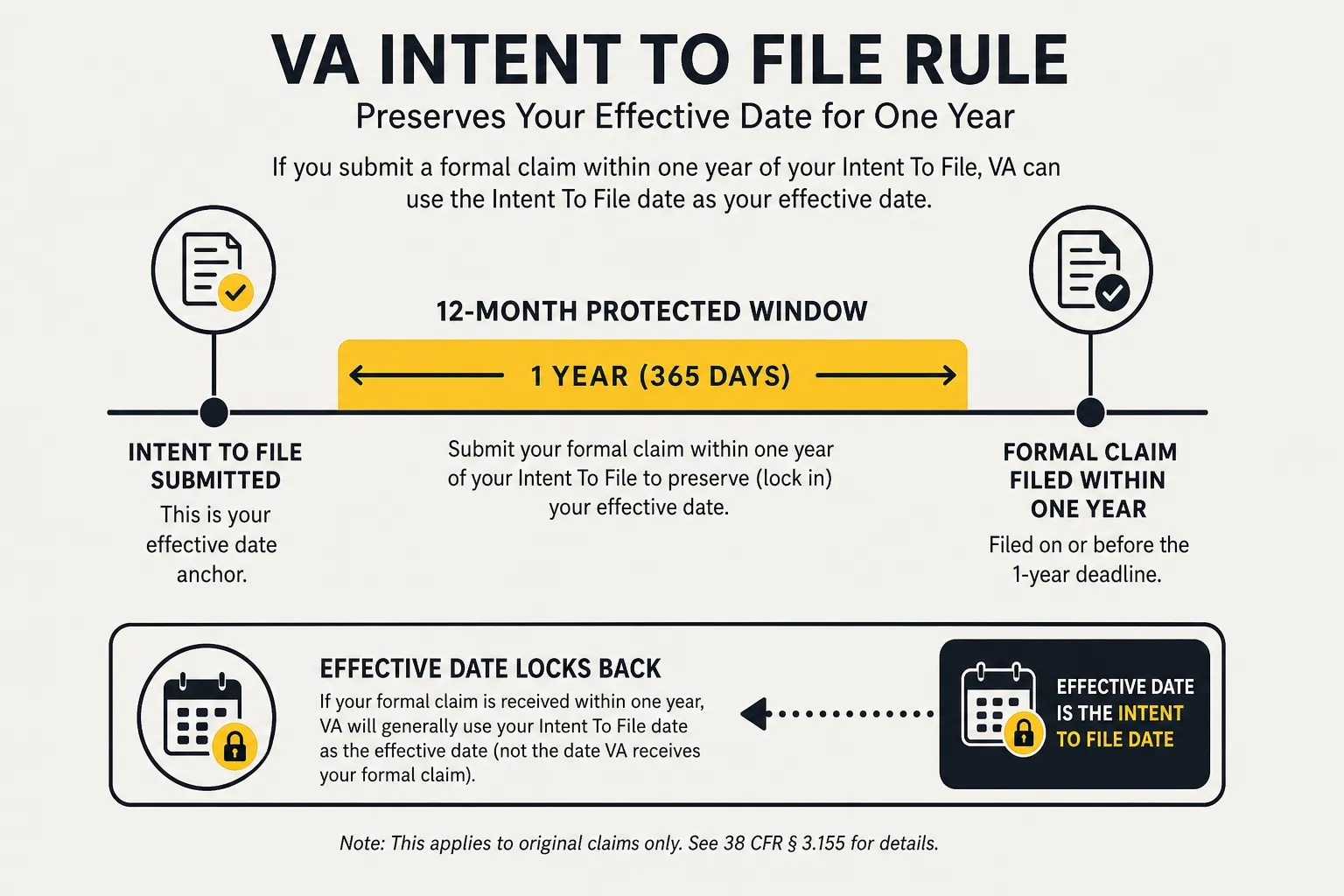
An intent to file tells the VA you plan to submit a claim. Once it is on record, you have one full year to actually complete and file the claim. If the claim is approved, your effective date can be set to the day you filed the intent rather than the later day you finished the full claim. That difference can be many months of back pay.
A few practical points that trip people up:
- The intent to file is valid for one year. File your complete claim inside that year and the early date holds. Let it lapse and you start over.
- If you file your disability claim online, the intent to file is set automatically on the day you start the application in your verified account. You do not need a separate form.
- You can also establish an intent to file by phone, by mail, or in person using VA Form 21-0966.
The strategic move is obvious once you see it. The moment you think you might file, even if you are nowhere near ready, log the intent. Then take your time assembling medical records, nexus letters, and buddy statements knowing your effective date is already protected. There is no downside and a great deal of potential back pay at stake.
PACT Act Back Pay in 2026
The PACT Act, signed August 10, 2022, expanded presumptive conditions for veterans exposed to burn pits, Agent Orange, and other toxic hazards. It came with a special retroactive provision that still affects back-pay calculations today.
If your benefits are granted under the PACT Act and you filed your intent to file on or before August 14, 2023, your effective date can reach all the way back to August 10, 2022, the day the law was signed. That can mean well over a year of additional back pay compared with a later effective date. The one-year filing deadline tied to that intent has passed, so for new PACT Act claims filed in 2026 the ordinary effective-date rules above apply: the date you file, or the date the condition began for presumptive claims within a year of separation. The takeaway for 2026 is to stop assuming the August 2022 backdate is automatic. Confirm your specific filing history before counting on it.
How to Estimate Your Back-Pay Amount
Once you understand your effective date, calculating back pay is arithmetic, but it has a few moving parts that make a calculator worth using.
The basic formula
Back pay is the monthly rate for your disability percentage, multiplied by the number of months from your effective date to the day your award begins paying monthly. The current rates took effect December 1, 2025, after a 2.8 percent cost-of-living adjustment. For a veteran with no dependents, the 2026 monthly rates run from $180.42 at 10 percent up to $3,938.58 at 100 percent, with the in-between ratings at $356.66 for 20 percent, $552.47 for 30 percent, $1,132.90 for 50 percent, and $1,808.45 for 70 percent. So a 50 percent veteran owed ten months of back pay at the current rate would be looking at roughly $11,329 before any dependent adjustments.
It is rarely that clean, though, for three reasons.
Rate changes over the back-pay period
If your effective date sits a year or two in the past, your back pay spans more than one rate year. Each December 1 the VA applies a new COLA, so a 24-month back-pay window is calculated in segments, each at the rate that was in effect for those months. The further back your effective date, the more rate tiers the math has to walk through. This is exactly the kind of step calculation that is easy to get wrong by hand.
Dependents change the rate
Your monthly amount climbs at ratings of 30 percent and above if you have a spouse, children, or dependent parents. If your dependency status changed during the back-pay period, say you married or had a child while the claim was pending, the rate has to shift mid-window too. The VA disability calculator handles dependents directly so you do not have to look up a separate table for each family configuration.
Combined ratings are not simple addition
If you have more than one service-connected condition, your overall percentage is not the sum of the individual ratings. The VA uses its own combined-ratings math, which always produces a number lower than straight addition. Your back pay is based on that combined figure, not the parts. If multiple conditions are involved, work out the combined rating first, and the combined VA disability ratings guide walks through exactly how that calculation works.
For the full month-by-month rate table behind these figures, see the 2026 VA disability rates guide. To turn your effective date and rating into an actual dollar estimate, run it through the disability calculator, which applies the current rates and dependent adjustments for you.
When and How Back Pay Is Paid
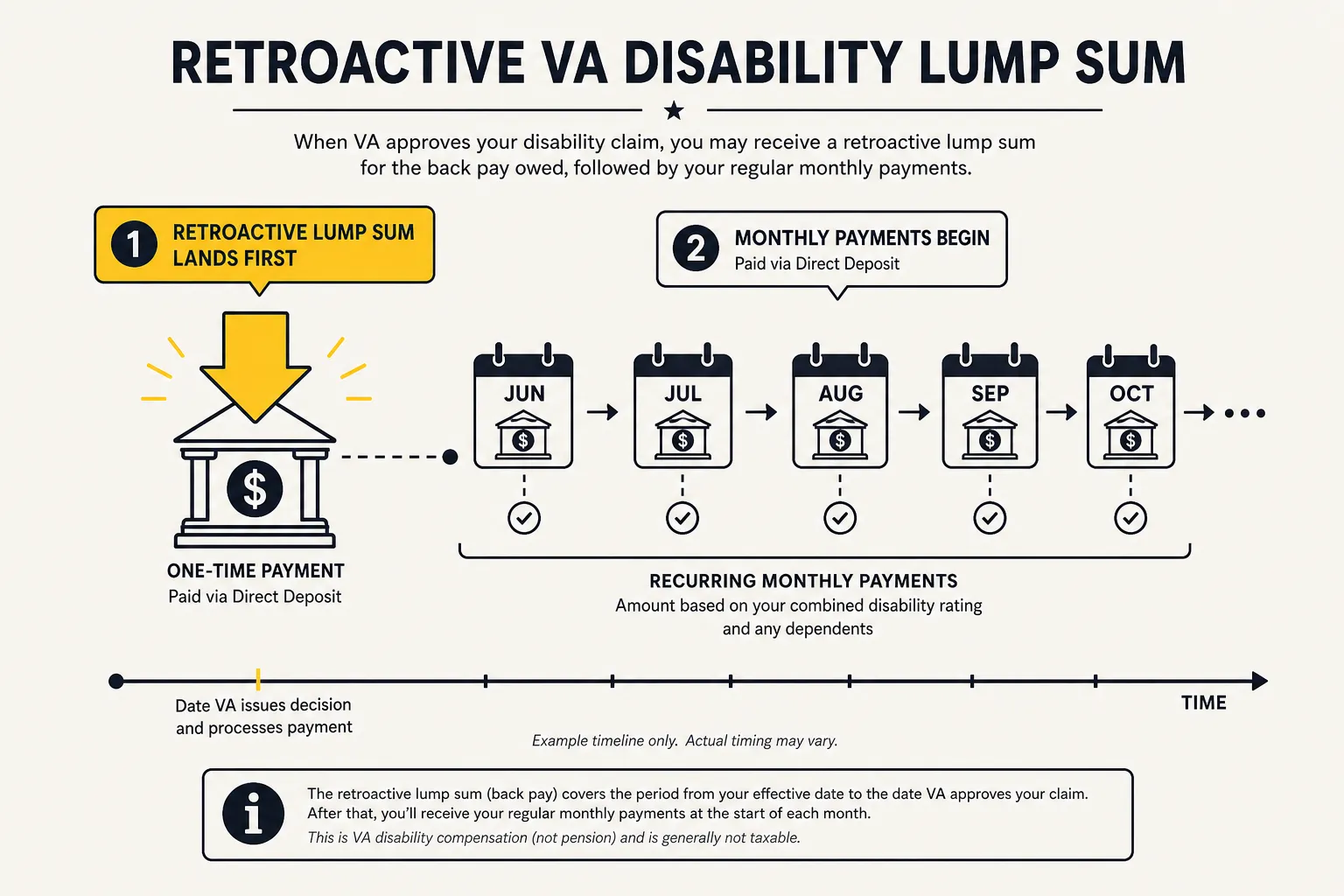
Back pay arrives as a lump sum, separate from your ongoing monthly compensation. A few details are worth setting straight.
VA disability compensation is paid in arrears, meaning each month's benefit is paid on the first business day of the following month. Your January benefit, for example, arrives the first business day of February. When the first of the month falls on a weekend or federal holiday, the VA pays on the last business day before it, so payments never arrive late.
The retroactive lump sum follows a different timeline from that monthly cycle. It is calculated and released when your award is processed, and for a decision showing at least a 10 percent rating you should see your first payment within 15 days. The VA pays by direct deposit or paper check, with direct deposit being both faster and the default for most veterans.
One caution: if you received military disability severance pay or certain separation benefits when you left service, the VA may recoup a portion of it from your disability back pay. This does not reduce your rating or your monthly rate going forward, but it can shrink the size of that first lump sum. If you took a separation payout, factor that in before you count on a specific number.
Common Back-Pay Mistakes to Avoid
The same handful of errors cost veterans real money every year:
- Not filing an intent to file. This is the big one. A two-minute online step protects up to a year of effective date. Skipping it is the most common way back pay quietly evaporates.
- Waiting past one year after separation. File within that first year and your effective date can reach back to the day after discharge. Cross the line and it resets to your filing date, erasing months of back pay.
- Sitting on an increase. If your condition has clearly worsened, the one-year window to backdate an increased rating is just as real as the original-claim window. Document the worsening and file.
- Assuming the PACT Act August 2022 backdate is automatic in 2026. That special provision required an intent to file on or before August 14, 2023. New claims now follow the standard rules.
- Forgetting severance recoupment. If you took disability severance at separation, expect the VA to offset part of your back pay. Knowing this in advance prevents an unwelcome surprise.
Frequently Asked Questions
How far back can VA disability back pay go?
It depends on your effective date. For an original claim filed within one year of separation, back pay can reach the day after you left service. File later and it generally starts the date the VA receives your claim. For increased ratings, it can reach back up to one year before filing if you can prove the worsening. The intent to file can push your effective date earlier than your full-claim date by up to a year.
How is VA back pay calculated?
It is your monthly compensation rate multiplied by the number of months between your effective date and the start of your monthly payments. If the period spans a December 1 rate change or a change in your dependents, each segment is calculated at the rate in effect for those months, then added together. Combined ratings use the VA's special math, not simple addition. The disability calculator applies the current rates and dependent adjustments to estimate your figure.
When will I receive my VA back pay?
If your decision notice shows a rating of at least 10 percent, the VA says your first payment, which typically includes your back pay, arrives within 15 days of the decision. It comes as a lump sum by direct deposit or check. Larger or more complex awards can take somewhat longer to fully process.
Is VA disability back pay taxed?
No. VA disability compensation, including retroactive back pay, is not subject to federal income tax, and states do not tax it either. You do not report it as income. This is one of the defining features of VA disability compensation compared with most other forms of income.
Does the intent to file really increase my back pay?
Yes, and it is the most reliable way to do so. Logging an intent to file sets a potential effective date up to a year before you finish the full claim, so the back pay covers that extra stretch. Filing a disability claim online sets the intent automatically on the day you start the application.
Will severance pay reduce my back pay?
It can. If you received disability severance or certain separation pay when you left service, the VA generally recoups a portion of it from your disability compensation, often taken out of the initial back-pay lump sum. Your monthly rate and rating are unaffected; only the size of the retroactive payment is reduced until the offset is satisfied.
Bottom Line
VA disability back pay is money you have already earned, paid late, and the amount lives or dies on your effective date. File within a year of separation to reach back to discharge, log an intent to file the moment you are considering a claim to protect up to a year, and act inside the one-year window when a condition worsens. The 2026 monthly rates, effective December 1, 2025, run from $180.42 to $3,938.58 for a veteran alone, but your real back-pay total depends on your rating, your dependents, and how many months your effective date covers. Confirm your effective date, then run your own numbers through the VA disability calculator instead of guessing. For the conditions that drive your rating in the first place, see how multiple disabilities combine in the combined ratings guide.