VA Disability Rates 2026: Full Pay Chart by Rating
The full 2026 VA disability rates pay chart for every rating from 10% to 100%, by dependent status, with the 2.8% COLA increase and how to read your monthly amount.

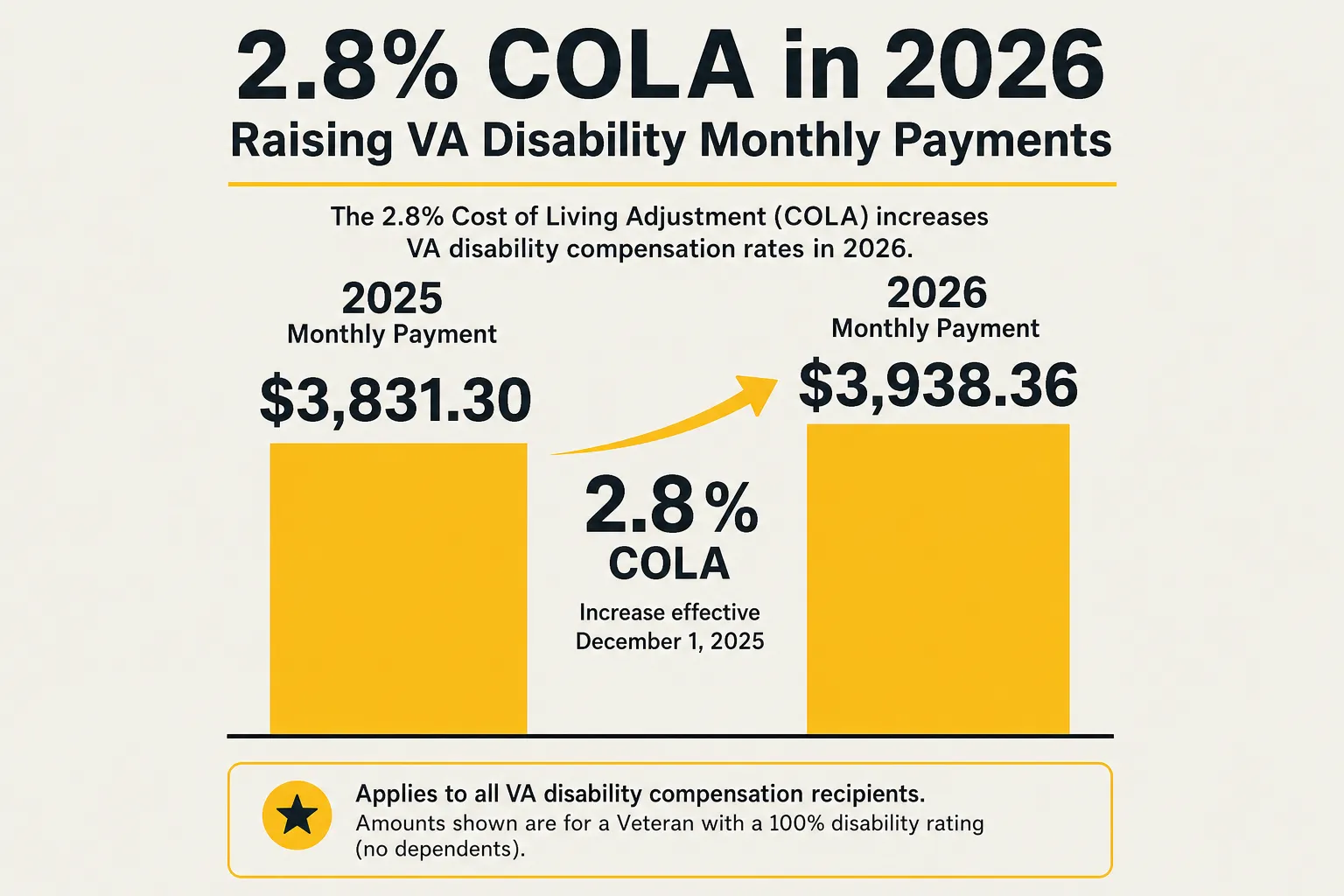
The 2026 VA disability rates went up 2.8 percent on December 1, 2025, the same cost-of-living adjustment Social Security received. Because the VA pays a month in arrears, the first check at the new rate landed in January 2026. This page is the full pay chart: every dollar figure for every rating from 10 percent through 100 percent, broken out by your dependent situation, pulled straight from VA.gov and matched to the official tables.
Two things drive your monthly amount and nothing else: your combined disability rating and the dependents you have on file. The numbers below are tax free, so the figure you see is the figure that hits your bank account. If you want your exact amount with your specific mix of spouse, children, and parents, run it through the VA disability calculator - it applies the same 2026 tables this guide uses. For everything else, here is the chart and how to read it.
The Short Version
- The 2026 COLA was 2.8 percent, effective December 1, 2025, first paid in January 2026.
- A veteran rated 100 percent with no dependents receives $3,938.58 a month in 2026.
- A veteran rated 10 percent receives $180.42; at 20 percent it is $356.66.
- Dependents only raise your check at 30 percent and above. At 10 and 20 percent the rate is flat no matter how many people you support.
- VA disability compensation is tax free at the federal level and in every state.
How the 2026 Rates Are Set
The VA does not pick these numbers. By law it matches the annual cost-of-living adjustment applied to Social Security benefits, which is tied to the Consumer Price Index for Urban Wage Earners and Clerical Workers, or CPI-W. For 2026 that adjustment came in at 2.8 percent. Every rate in the tables below is the prior 2025 amount raised by that percentage and rounded to the cent under the VA's rounding rules.
The effective date is the part people get wrong. The increase takes effect December 1, 2025, but the VA pays compensation for a month on the first business day of the following month. So your December 2025 benefit, paid in early January 2026, is the first one at the new rate. That timing is the same every year.
These rates apply to compensation for service-connected disability. The same 2.8 percent COLA also lifted Special Monthly Compensation, Dependency and Indemnity Compensation, and VA pension, but those run on separate tables and are not covered here.
2026 Rates at 10 Percent and 20 Percent
If your combined rating is 10 or 20 percent, the rate is a single flat number. Dependents do not change it. You can have a spouse, three children, and two dependent parents and the amount is identical to a single veteran at the same rating.
| Disability rating | Monthly amount |
|---|---|
| 10% | $180.42 |
| 20% | $356.66 |
The dependent rules kick in only once your rating reaches 30 percent. That cutoff is set in statute and it is the reason the tables below suddenly get wider.
2026 Rates: 30 Percent Through 60 Percent
Starting at 30 percent, the VA pays more when you have a dependent spouse, dependent children, or dependent parents on file. The table below shows the basic monthly rate for the most common dependent combinations. Find your rating across the top and your dependent status down the left.
| Dependent status | 30% | 40% | 50% | 60% |
|---|---|---|---|---|
| Veteran alone | $552.47 | $795.84 | $1,132.90 | $1,435.02 |
| With spouse, no children | $617.47 | $882.84 | $1,241.90 | $1,566.02 |
| With spouse and 1 child | $666.47 | $947.84 | $1,322.90 | $1,663.02 |
| With 1 parent, no spouse | $604.47 | $865.84 | $1,220.90 | $1,540.02 |
| With 2 parents, no spouse | $656.47 | $935.84 | $1,308.90 | $1,645.02 |
| With spouse and 1 parent | $669.47 | $952.84 | $1,329.90 | $1,671.02 |
| With spouse and 2 parents | $721.47 | $1,022.84 | $1,417.90 | $1,776.02 |
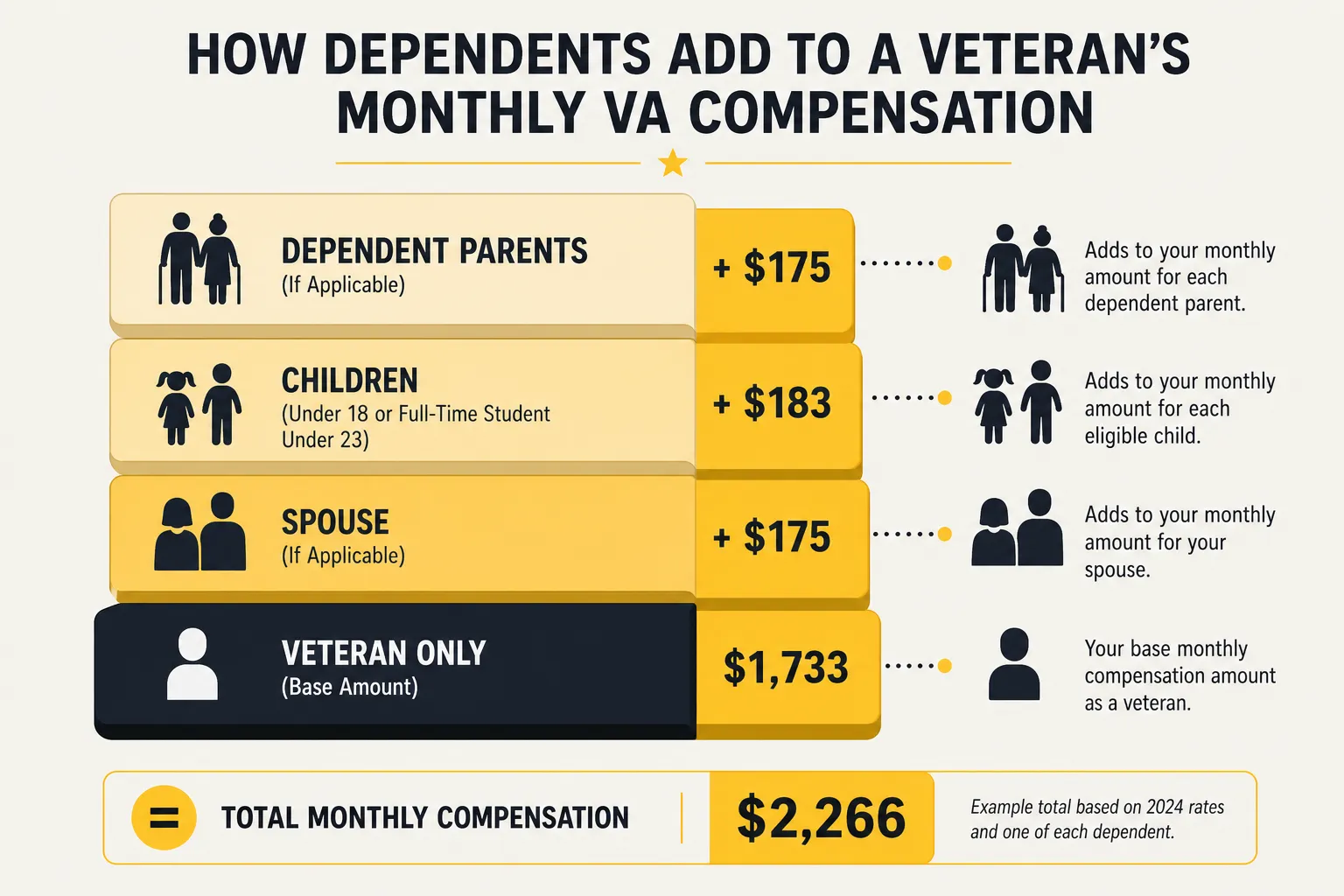
The basic rate already builds in one spouse, one child, or the parents shown. For each dependent beyond what the row covers, you add a separate amount.
Added amounts, 30 to 60 percent
These are added on top of the basic rate, per extra dependent:
| Added for | 30% | 40% | 50% | 60% |
|---|---|---|---|---|
| Each additional child under 18 | $32.00 | $43.00 | $54.00 | $65.00 |
| Each additional child over 18 in a qualifying school program | $105.00 | $140.00 | $176.00 | $211.00 |
| Spouse receiving Aid and Attendance | $61.00 | $81.00 | $101.00 | $121.00 |
So a veteran rated 50 percent with a spouse and three children starts at the "spouse and 1 child" rate of $1,322.90, then adds two more children under 18 at $54.00 each, landing at $1,430.90. The arithmetic is simple once you know which row is your starting point, but it is exactly the kind of stacking the calculator handles without you counting on your fingers.
2026 Rates: 70 Percent Through 100 Percent
This is where the dollar figures get serious, and where the jump from 90 to 100 percent is large enough to be worth its own line. Same layout as before: rating across the top, dependent status down the side.
| Dependent status | 70% | 80% | 90% | 100% |
|---|---|---|---|---|
| Veteran alone | $1,808.45 | $2,102.15 | $2,362.30 | $3,938.58 |
| With spouse, no children | $1,961.45 | $2,277.15 | $2,559.30 | $4,158.17 |
| With spouse and 1 child | $2,074.45 | $2,406.15 | $2,704.30 | $4,318.99 |
| With 1 parent, no spouse | $1,931.45 | $2,242.15 | $2,520.30 | $4,114.82 |
| With 2 parents, no spouse | $2,054.45 | $2,382.15 | $2,678.30 | $4,291.06 |
| With spouse and 1 parent | $2,084.45 | $2,417.15 | $2,717.30 | $4,334.41 |
| With spouse and 2 parents | $2,207.45 | $2,557.15 | $2,875.30 | $4,510.65 |
Added amounts, 70 to 100 percent
| Added for | 70% | 80% | 90% | 100% |
|---|---|---|---|---|
| Each additional child under 18 | $76.00 | $87.00 | $98.00 | $109.11 |
| Each additional child over 18 in a qualifying school program | $246.00 | $281.00 | $317.00 | $352.45 |
| Spouse receiving Aid and Attendance | $141.00 | $161.00 | $181.00 | $201.41 |
Why 100 Percent Pays So Much More Than 90 Percent
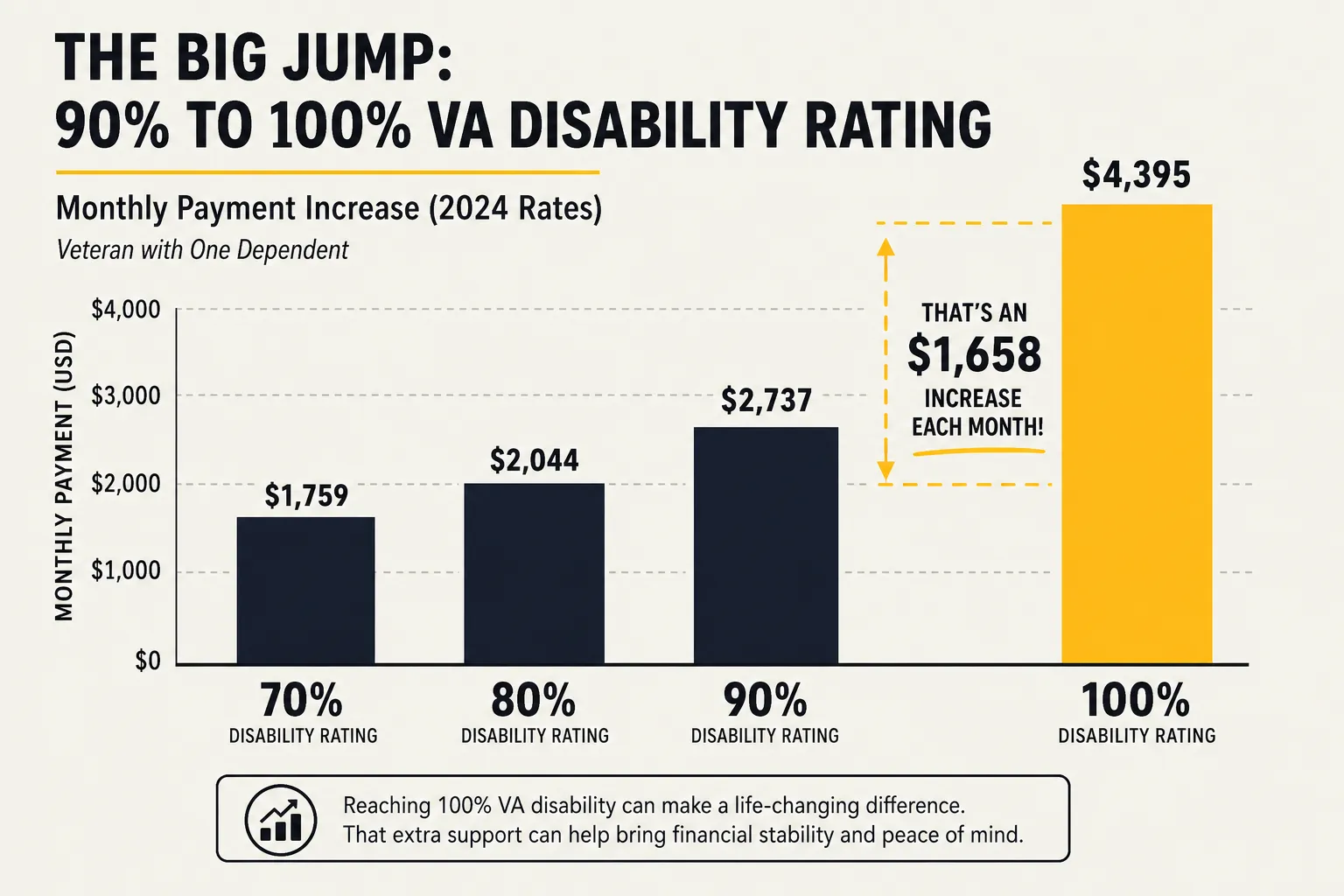
Look at the veteran-alone column. From 70 to 80 percent the increase is about $294. From 80 to 90 percent it is about $260. Then from 90 to 100 percent the payment leaps from $2,362.30 to $3,938.58, a jump of more than $1,576 a month. That is not a typo and it is not a mistake in the chart. The rate schedule is built that way on purpose: 100 percent is meant to compensate for a disability that totally prevents gainful employment, so the top rung sits far above the others.
This is also why so many disputes and claims focus on getting from 90 to 100 percent. The difference is worth roughly $18,900 a year for a single veteran, and more with dependents. It is the single largest step in the entire schedule.
There is a second route to that 100 percent payment level called Total Disability based on Individual Unemployability, or TDIU. A veteran rated below 100 percent who cannot hold down substantially gainful work because of service-connected conditions can be paid at the 100 percent rate even though the schedular rating is lower, often 70 percent. The dollar amount is identical to the 100 percent column above. TDIU has its own eligibility tests, but the takeaway for this chart is simple: if you are on TDIU, use the 100 percent row.
How Dependent Status Changes Your Check
The tables above only show common combinations. The VA recognizes more dependent situations than fit cleanly in a grid, so here is the logic behind the numbers.
Who counts as a dependent
For VA compensation purposes your dependents can include a current spouse, unmarried children under 18, unmarried children between 18 and 23 who are enrolled in an approved school program, children of any age who became permanently incapable of self-support before turning 18, and dependent parents whose income and net worth fall under VA limits. A spouse who needs the regular aid and attendance of another person adds the extra amount shown in the added-amounts table.
Why your dependents have to be on file
The higher rates are not automatic. The VA pays them only for dependents recorded in your file, usually through your enrollment in DEERS and a dependency claim. If you marry, have a child, or take on a dependent parent and never tell the VA, you keep getting paid at the lower veteran-alone rate. File the dependency claim and the VA can pay back to the date the dependent became eligible, but the burden is on you to report the change. The reverse matters too: a divorce or a child aging out should be reported promptly, because an overpayment will be recovered later.
Are These Payments Taxable? No.
VA disability compensation is not taxable. It is excluded from gross income on your federal return, and no state taxes it either. You do not report it as income, it does not affect your tax bracket, and the figures in every table above are the full amount you receive. That tax-free status is a big part of why a VA disability dollar is worth more than a dollar of taxable wages or even taxable military retired pay.
One related point that confuses retirees: if you receive both military retired pay and VA disability compensation, the rules on offsetting the two (and programs like Concurrent Retirement and Disability Pay) are separate from the rate chart here. The disability amount itself stays tax free regardless.
How to Use This Chart With Your Own Numbers
Reading a static table only gets you so far, because real situations stack. A 70 percent veteran with a spouse, two kids, and one dependent parent is not one row, it is a base row plus added amounts. To get your exact 2026 figure:
- Confirm your combined rating. If you have more than one service-connected condition, your combined rating is not the simple sum of the individual ratings - the VA uses its own combined-ratings math. Work that out first in the VA disability combined ratings guide.
- Identify your dependent status and pick the closest starting row above.
- Add for any dependents beyond what that row includes, using the added-amounts table for your rating.
Or skip the manual stacking and let the VA disability calculator do all three steps at once with your real dependents. It is loaded with these exact 2026 tables, so the output matches what the VA will actually pay.
Frequently Asked Questions
What are the 2026 VA disability rates?
The 2026 VA disability rates rose 2.8 percent effective December 1, 2025, first paid in January 2026. A veteran with no dependents receives $180.42 at 10 percent, $356.66 at 20 percent, and $3,938.58 at 100 percent. Rates between those rise with both your rating and your dependents. The full pay chart by rating and dependent status is in the tables above.
How much is 100 percent VA disability in 2026?
A 100 percent disabled veteran with no dependents receives $3,938.58 per month in 2026, tax free. With a spouse and no children it is $4,158.17, and with a spouse and one child it is $4,318.99. Additional children and a spouse needing Aid and Attendance add more on top. Veterans on TDIU are paid at this same 100 percent rate.
What was the 2026 VA disability COLA increase?
The 2026 cost-of-living adjustment was 2.8 percent. The VA is required by law to match the COLA applied to Social Security benefits, which is based on the CPI-W inflation measure. The increase took effect December 1, 2025, and the first payment at the new rate arrived in early January 2026.
Do dependents increase VA disability pay at every rating?
No. Dependents only increase your monthly payment if your combined rating is 30 percent or higher. At 10 and 20 percent the rate is a single flat amount regardless of how many dependents you have. From 30 percent up, a spouse, children, and dependent parents each add to your check, but only if they are recorded in your VA file.
Is VA disability compensation taxable in 2026?
No. VA disability compensation is tax free at the federal level and in all states. You do not report it as income and it does not affect your tax bracket. Every dollar figure in the 2026 pay chart is the full, untaxed amount deposited to your account.
Why is there such a big jump from 90 to 100 percent?
The rate schedule is intentionally steep at the top because 100 percent is meant to reflect a disability that totally prevents gainful work. A single veteran goes from $2,362.30 at 90 percent to $3,938.58 at 100 percent, a difference of more than $1,576 a month, or roughly $18,900 a year. It is the largest single step in the entire rating schedule.
Bottom Line
The 2026 VA disability rates are the 2025 amounts plus a 2.8 percent COLA, live since December 1, 2025 and paid starting January 2026. The chart on this page is the complete picture: flat rates at 10 and 20 percent, then dependent-adjusted tables from 30 through 100 percent, capped by the $3,938.58 single-veteran rate at 100 percent. Tax free, every dollar. To turn the chart into your exact monthly number with your real spouse, children, and parents, run it through the VA disability calculator, and if you have more than one rated condition, settle your combined rating first with the combined ratings guide.