VA Disability Rating for PTSD: 30, 50, 70 & 100 Percent
How the VA disability rating for PTSD works in 2026 - the 38 CFR 4.130 criteria for 30, 50, 70, and 100 percent, what each level means, and how the rating turns into a monthly payment.

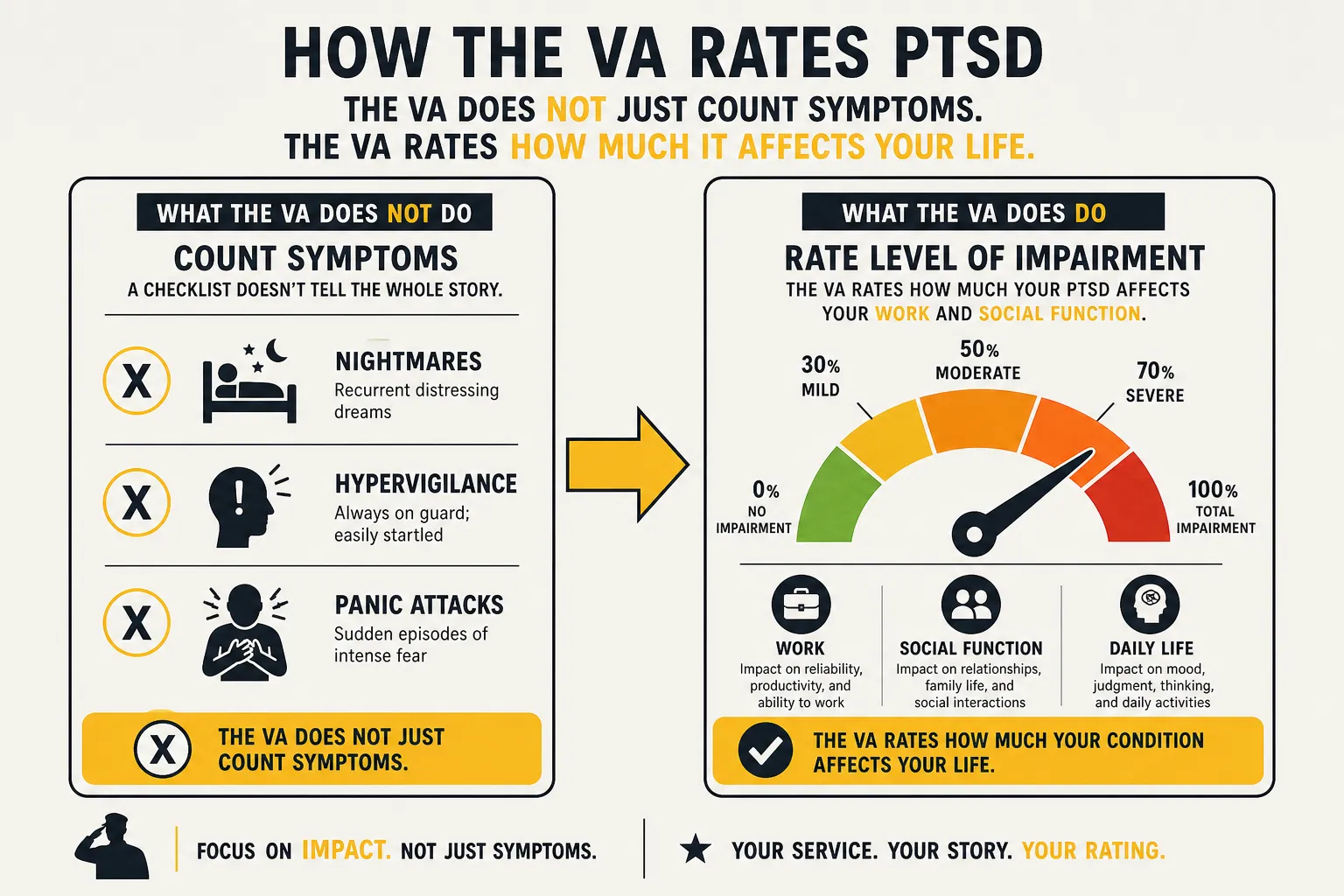
The VA disability rating for PTSD almost always lands at 30, 50, 70, or 100 percent, and which one you get is not decided by how bad your symptoms sound on paper. It is decided by how much the condition interferes with your ability to work and to function socially. That is the single most misunderstood part of the whole system. Two veterans can describe identical nightmares, hypervigilance, and panic attacks and still walk away with very different ratings, because the VA is not scoring the symptoms themselves. It is scoring the impairment those symptoms cause.
This guide breaks down what each rating level actually means under the federal regulation that governs it, why the gaps between levels are so wide, and how a rating percentage turns into a real monthly check. Because the dollar amounts and dependent add-ons change every year and depend on your family situation, run your own numbers through the VA disability calculator as you read rather than trusting a number you saw on a forum. This is general information about how the rating system works, not medical advice or claims advice. For anything specific to your claim, talk to an accredited Veterans Service Officer or your VA care team.
The Rule That Governs Every PTSD Rating
Every mental health rating the VA assigns, including PTSD, comes from one place: the General Rating Formula for Mental Disorders in 38 CFR 4.130. PTSD has its own diagnostic code (9411), but it is rated on the exact same scale as depression, generalized anxiety, bipolar disorder, and most other service-connected mental conditions. There is no separate, tougher or easier scale for PTSD.
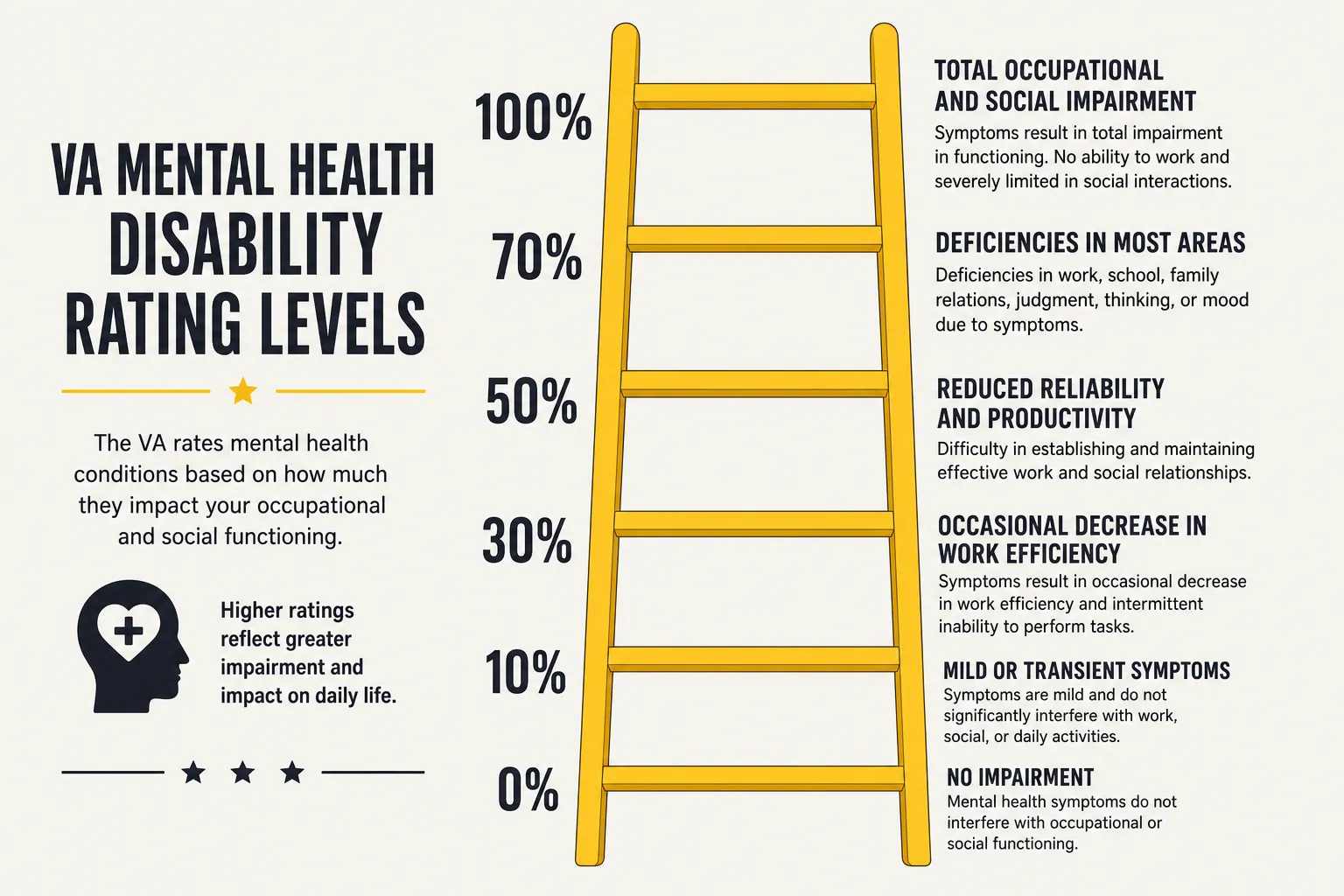
The formula offers only six possible ratings: 0, 10, 30, 50, 70, and 100 percent. There is nothing in between. You cannot be rated 40 or 60 or 85 percent for a mental health condition. This is why so many decisions feel like a jump - the rating is forced to round to one of those six rungs.
One thing worth knowing in 2026: the VA has discussed moving mental health ratings toward a newer, domain-based model, and you will see articles describing it. As of mid-2026 those changes are proposed, not finalized, and the General Rating Formula described in this guide is still the rule in effect. If that ever changes, the VA disability calculator and this guide get updated to match.
Symptoms Are Examples, Not a Checklist
Here is the detail that trips up almost everyone reading their own decision letter. Each rating level lists a set of symptoms, but those symptoms are introduced with the phrase "due to such symptoms as." That wording is doing a lot of work. The list is a set of examples that illustrate a level of impairment. It is not a checklist you have to match item for item.
What the rater is actually deciding is your overall level of occupational and social impairment - how much the condition degrades your ability to hold a job and maintain relationships. The symptoms are evidence of where you fall on that scale, not the scale itself. Courts have been clear on this: a veteran does not need to show every symptom in a tier, and a symptom not on the list can still support a higher rating if it produces the same level of impairment. The headline language of each level - "reduced reliability and productivity," "deficiencies in most areas," "total impairment" - is what really controls the rating.
That is why the same nightmares can produce a 30, a 50, or a 70. The question is never just "do you have nightmares." It is "how much does this condition stop you from functioning," and the symptoms are how you prove the answer.
What Each PTSD Rating Level Means
Below is what each level requires, paraphrased in plain English, with the regulation's own example symptoms. The exact regulatory text lives in 38 CFR 4.130, and a rater reads your specific evidence against it.
30 Percent
A 30 percent rating reflects occupational and social impairment with an occasional decrease in work efficiency and intermittent periods where you cannot perform tasks, even though you are generally functioning satisfactorily most of the time, with routine behavior, self-care, and normal conversation intact.
The regulation's example symptoms at this level include depressed mood, anxiety, suspiciousness, panic attacks weekly or less often, chronic sleep impairment, and mild memory loss such as forgetting names, directions, or recent events. The picture here is someone who is mostly holding it together at work and at home but loses ground periodically.
50 Percent
A 50 percent rating reflects occupational and social impairment with reduced reliability and productivity. This is a real step up. You are not just having occasional bad stretches; the condition is dragging down how dependably and how much you can produce.
Example symptoms at this level include flattened affect; circumstantial, circumlocutory, or stereotyped speech; panic attacks more than once a week; difficulty understanding complex commands; impairment of short and long-term memory (for example, retaining only highly learned material, forgetting to complete tasks); impaired judgment; impaired abstract thinking; disturbances of motivation and mood; and difficulty establishing and maintaining effective work and social relationships.
70 Percent
A 70 percent rating reflects occupational and social impairment with deficiencies in most areas - work, school, family relations, judgment, thinking, or mood. The word "most" matters. The condition is now compromising you across nearly every part of your life at once.
Example symptoms at this level include suicidal ideation; obsessional rituals that interfere with routine activities; speech that is intermittently illogical, obscure, or irrelevant; near-continuous panic or depression affecting the ability to function independently, appropriately, and effectively; impaired impulse control such as unprovoked irritability with periods of violence; spatial disorientation; neglect of personal appearance and hygiene; difficulty adapting to stressful circumstances including a work or work-like setting; and an inability to establish and maintain effective relationships. The presence of any of these in a way that produces deficiencies in most areas can support a 70.
100 Percent
A 100 percent rating reflects total occupational and social impairment. This is the top of the scale, and the bar is exactly what it sounds like: the condition leaves you unable to function in work and social settings, period.
Example symptoms at this level include gross impairment in thought processes or communication; persistent delusions or hallucinations; grossly inappropriate behavior; persistent danger of hurting self or others; intermittent inability to perform activities of daily living including maintenance of minimal personal hygiene; disorientation to time or place; and memory loss for names of close relatives, your own occupation, or your own name. These are extreme presentations, and a schedular 100 percent for PTSD alone is uncommon.
0 and 10 Percent
Below 30, the two lowest rungs cover milder cases. A 10 percent rating applies when the condition causes mild or transient symptoms that decrease work efficiency only during periods of significant stress, or symptoms controlled by continuous medication. A 0 percent rating means PTSD has been formally diagnosed but the symptoms are not severe enough to interfere with work and social functioning or to require continuous medication. A 0 percent rating still establishes service connection, which matters - it keeps the door open if the condition worsens later.
Why the Jump From 50 to 70 Is the Big One
If you study the language, the most consequential line in the whole formula sits between 50 and 70 percent. At 50 the standard is "reduced reliability and productivity." At 70 it is "deficiencies in most areas." That is the difference between a condition that drags down your output and a condition that compromises nearly everything.
This jump matters for a practical reason beyond the words. It moves a veteran well past the schedular gateway for total disability based on individual unemployability, usually called TDIU. The schedular bar for TDIU is one service-connected disability rated at least 60 percent, or two or more disabilities with at least one rated 40 percent and a combined rating of at least 70 percent. Because PTSD is rated on its own, a single 60 percent PTSD rating already clears the schedular threshold - but since the mental health formula has no 60 rung, the first PTSD level that meets it on its own is 70 percent. TDIU lets a veteran who cannot hold down substantially gainful employment because of service-connected conditions be paid at the 100 percent rate even though the schedular rating is below 100. For many PTSD claims, the realistic path to a 100 percent payment is not a schedular 100 - it is a 70 percent rating plus TDIU. The eligibility rules and the application are their own topic, and an accredited representative can tell you whether you qualify.
How a PTSD Rating Becomes a Monthly Payment
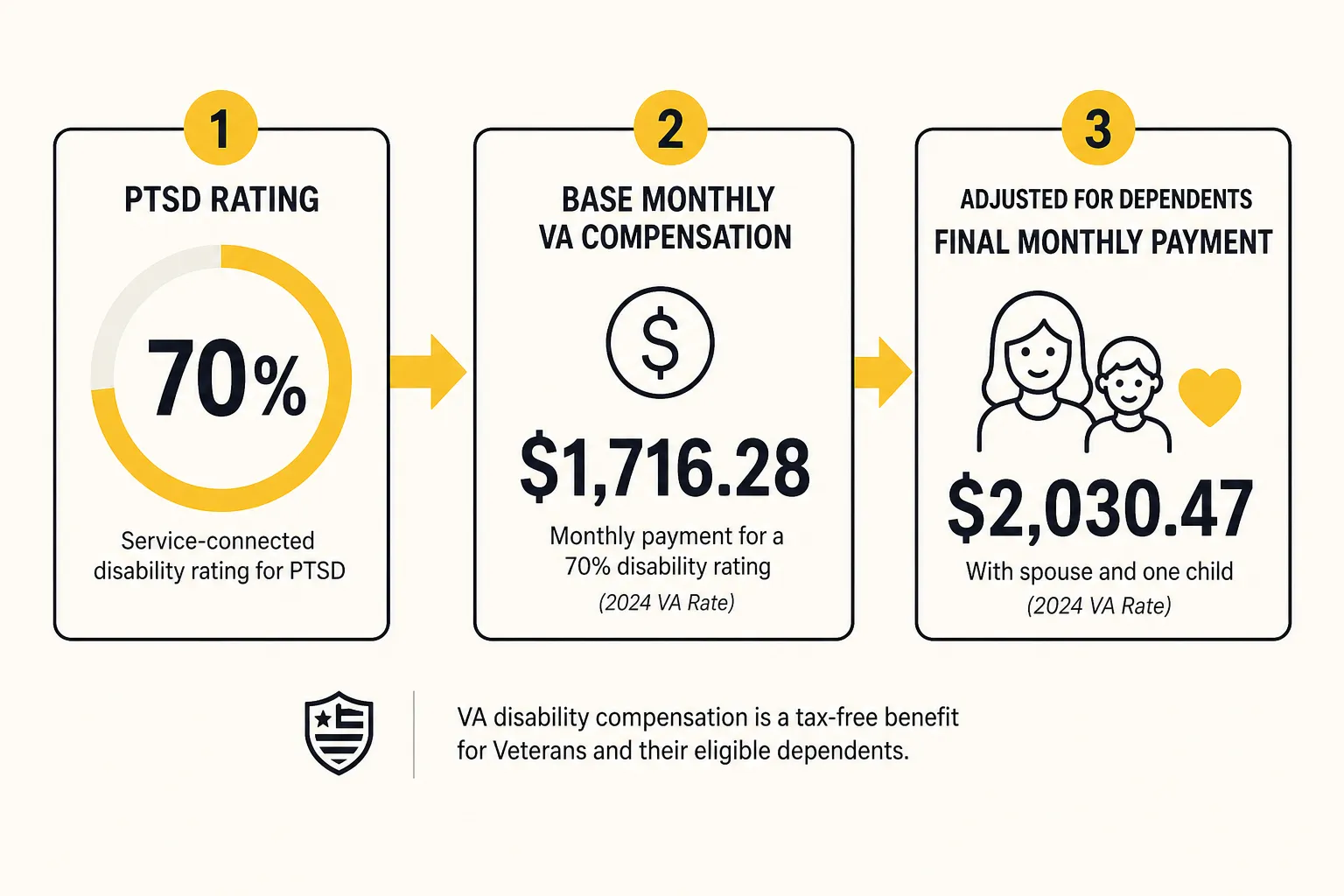
A rating percentage is not a payment. It is a key that unlocks a fixed monthly dollar amount set by Congress and adjusted each December for the cost of living. The amount depends on your rating and on how many dependents you have - a spouse, children under 18 (or older if in school or permanently disabled), and dependent parents.
The 2026 rates took effect December 1, 2025. For a veteran with no dependents, the base monthly amounts are:
| Rating | Monthly amount (veteran alone, 2026) |
|---|---|
| 30% | $552.47 |
| 50% | $1,132.90 |
| 70% | $1,808.45 |
| 100% | $3,938.58 |
Dependents push these higher. Add-ons start at the 30 percent level - below 30 percent, dependent status does not change your payment. As an example, a veteran rated 100 percent with a spouse and no other dependents receives $4,158.17 a month rather than the $3,938.58 base. The exact add-on for your family depends on how many children you have, whether your spouse needs aid and attendance, and whether you support dependent parents, so the cleanest way to get your real figure is to enter your rating and family in the VA disability calculator.
Two more wrinkles worth knowing. First, this compensation is tax-free at both the federal and state level. Second, if you carry more than one service-connected condition, the VA does not simply add the percentages. It uses "combined ratings" math that almost always produces a lower combined number than straight addition would. PTSD frequently shows up alongside other conditions, so if that is your situation, the VA combined ratings guide explains how the final number is built.
What Actually Moves a PTSD Rating
Since the rating tracks impairment rather than a symptom checklist, the evidence that moves a decision is evidence about function. A few things matter more than people expect.
- The Compensation and Pension (C&P) exam. This is the single most influential piece of evidence in most claims. The examiner completes a Disability Benefits Questionnaire that maps your presentation onto the same impairment levels described above. How you function on the day of the exam, and how honestly the exam captures your worst days, carries enormous weight.
- Consistent treatment records. Ongoing notes from VA or private mental health providers that document your symptoms and their effect over time are harder to discount than a single snapshot.
- Lay statements. Statements from a spouse, coworkers, or fellow service members describing concrete changes in your behavior - missed work, lost relationships, anger episodes - speak directly to occupational and social impairment in a way clinical notes sometimes do not.
- Occupational evidence. Performance write-ups, a reduction in hours, lost jobs, or a documented inability to keep work all map straight onto the regulation's language about work efficiency and reliability.
The throughline is that the system rewards showing impact, not just listing diagnoses. None of this is claims advice - an accredited Veterans Service Officer can help you assemble it correctly and for free.
Common Misconceptions
A few beliefs cause a lot of frustration:
- "More symptoms automatically means a higher rating." Not true. A long symptom list that still leaves you generally functional supports a lower rating than a shorter list that wrecks your ability to work.
- "PTSD has a special harder scale." It does not. PTSD is rated on the same General Rating Formula as other mental health conditions.
- "A rating is permanent." Most are not. The VA can schedule reexaminations, and a rating can go up or down if your condition changes, though long-held and stable ratings gain protections over time.
- "100 percent is the only way to be paid at the 100 percent rate." Also not true, because of TDIU. A schedular rating that meets the TDIU bar - for PTSD alone, 70 percent on the mental health formula - paired with TDIU pays at the 100 percent rate for veterans who cannot work because of their service-connected conditions.
Frequently Asked Questions
What is the most common VA disability rating for PTSD?
There is no official "most common" figure published, but PTSD claims that are granted most often land at 30, 50, or 70 percent, because those tiers describe the range from periodic work disruption up to deficiencies in most areas of life. A schedular 100 percent for PTSD alone is comparatively rare because it requires total occupational and social impairment. Your own rating depends entirely on how much the condition impairs your functioning, which is what the C&P exam and your records establish.
How much does a 70 percent PTSD rating pay in 2026?
For a veteran with no dependents, a 70 percent rating pays $1,808.45 per month under the 2026 rates that took effect December 1, 2025. Dependents raise that amount. A 70 percent rating is also the level where many veterans become eligible to pursue TDIU, which can pay at the 100 percent rate. Enter your rating and dependents in the VA disability calculator for your exact figure.
Can I get 100 percent for PTSD?
Yes, in two ways. A schedular 100 percent requires total occupational and social impairment under 38 CFR 4.130, which is an extreme presentation. More commonly, veterans reach the 100 percent payment rate through TDIU - total disability based on individual unemployability - which pays at the 100 percent rate when a service-connected condition makes substantially gainful employment impossible. Schedularly, TDIU needs one disability rated at least 60 percent (a 70 percent PTSD rating clears this comfortably) or two-plus disabilities with one at 40 percent and a combined 70 percent. Whether you qualify is a claims question for an accredited representative.
Is VA disability for PTSD taxed?
No. VA disability compensation is not taxable at the federal level, and states do not tax it either. The monthly amounts shown for each rating are what you actually receive, with no income tax withheld.
How does the VA decide between two rating levels?
The rater compares your evidence against the headline standard for each level - "occasional decrease in work efficiency" at 30, "reduced reliability and productivity" at 50, "deficiencies in most areas" at 70, and "total impairment" at 100. The example symptoms in each tier are evidence of where you fall, not a checklist you must fully match. When the evidence is mixed, the rule is to assign the level that most nearly approximates your overall impairment.
What if I have PTSD plus other service-connected conditions?
The VA does not add the percentages together. It uses combined ratings math, which almost always yields a number lower than straight addition (and never higher). PTSD often appears alongside other conditions like tinnitus, sleep apnea, or a musculoskeletal injury, so your final combined rating is calculated from all of them together. See the VA combined ratings guide for how that math works, and check the year's full pay chart in the 2026 VA disability rates guide.
Bottom Line
The VA disability rating for PTSD comes down to one question asked four different ways: how much does this condition stop you from working and living a normal social life? A 30 percent rating means occasional disruption, 50 means reduced reliability, 70 means deficiencies in most areas, and 100 means total impairment. The symptoms listed at each level are examples that prove where you fall, not boxes to tick. Because the formula rounds to just six rungs and because TDIU can pay a 70 percent veteran at the full rate, the practical picture is more nuanced than a single percentage suggests. Confirm your real monthly figure by running your rating and dependents through the VA disability calculator, and lean on an accredited Veterans Service Officer for anything specific to your claim.